 Jeedeson Official Website
Bamboo flooring now shows up in more American homes than ever — but most buying advice online is either marketing copy or guesswork. This guide does it differently: every claim below is backed by published test data (Janka hardness ratings, CARB formaldehyde limits, industry cost ranges), and we’ll be honest about where bamboo loses to the alternatives. That includes a full cleaning and refinishing manual, because “how to clean bamboo flooring” is the single most-asked bamboo question in the US — and the answer decides whether your floor lasts 10 years or 25.
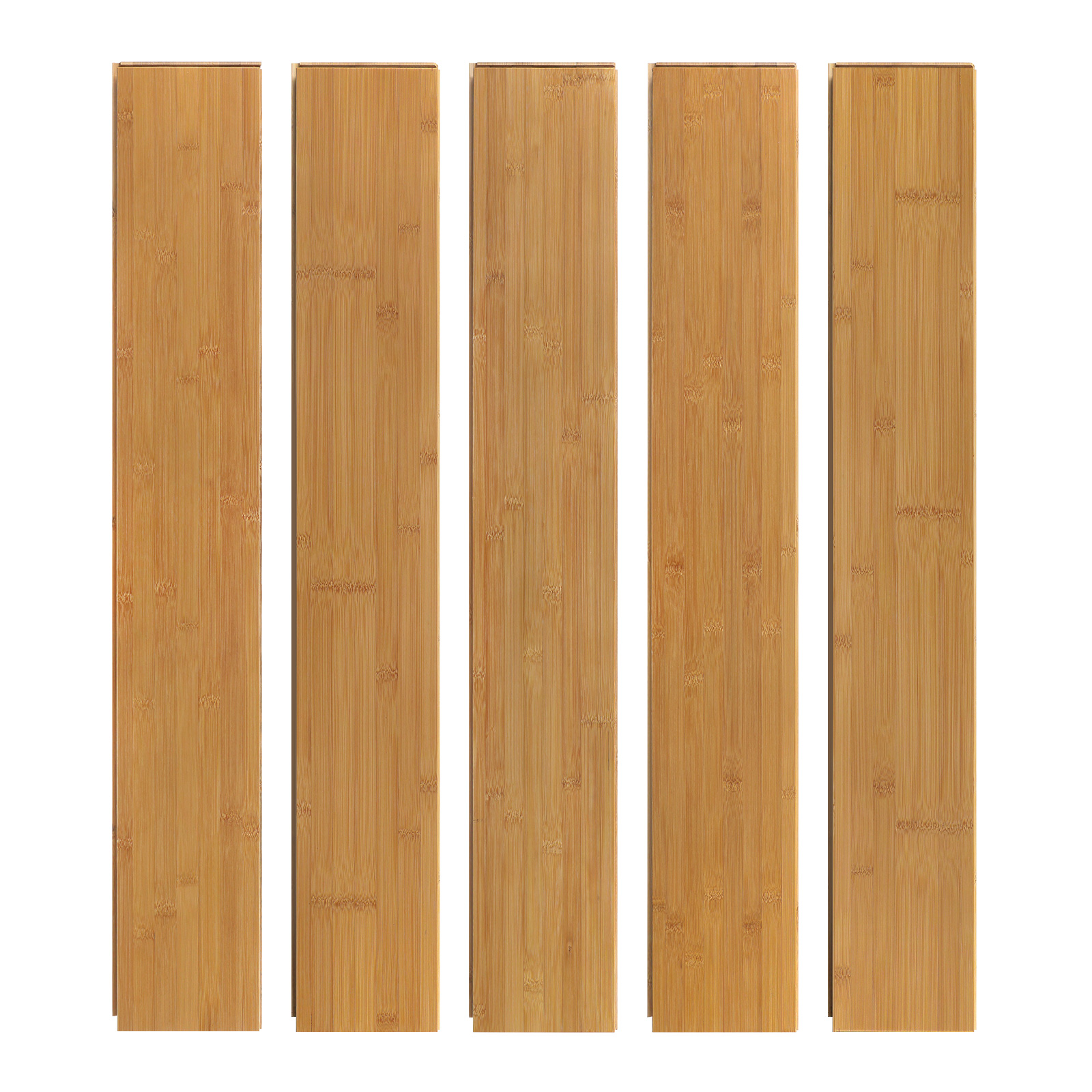
1. Is Bamboo a Hardwood? (No — It’s a Grass, and That Matters)
Let’s clear up the most common misconception first. Bamboo is not a tree and not a hardwood — it’s a grass (the moso species, Phyllostachys edulis, is used for virtually all flooring). It reaches harvest maturity in 5–7 years, versus 40–60 years for an oak tree, and it regrows from the same root system without replanting.
So why is it sold alongside hardwood? Because when its fibers are processed correctly, it can match or beat hardwood on the industry hardness test. The Janka test measures the force (in pounds-force, lbf) needed to press a steel ball halfway into a board — higher numbers mean better dent resistance. Here’s how the materials actually compare:
| Material | Approx. Janka hardness (lbf) | Note |
|---|---|---|
| Strand-woven bamboo | 3,000–4,000+ | Varies by lot and process; treat claims above 4,000 with care |
| Ipe (Brazilian walnut) | 3,500–3,680 | Reference exotic hardwood |
| Brazilian cherry (jatoba) | 2,350 | |
| Hickory | 1,820 | Hardest common US domestic species |
| Hard maple | 1,450 | |
| Natural horizontal/vertical bamboo | ~1,380 | Roughly equal to white oak |
| White oak | 1,360 | |
| Red oak | 1,290 | The industry benchmark |
| Carbonized bamboo | ~1,180 | Heat treatment softens the fibers |
| Black walnut | 1,010 |
Published industry ranges; bamboo has no national grading standard, so exact numbers vary by harvest age, density, and adhesive content. Sources: published Janka tables for US domestic species and strand-woven bamboo industry disclosures.
2. The Four Constructions of Bamboo Flooring (and Which One to Buy)
“Bamboo flooring” describes several materials with almost nothing in common mechanically. This is the single biggest factor in your purchase — bigger than color, bigger than brand.
| Construction | How it’s made | Janka (lbf) | Best for | Watch out |
|---|---|---|---|---|
| Strand-woven | Fibers crushed, mixed with resin, pressed under heat and extreme pressure | 3,000–4,000+ | Pets, kids, hallways, commercial spaces | Heaviest; very hard to sand |
| Solid (horizontal/vertical) | Bamboo strips laminated flat or on edge through the full plank thickness | ~1,380 | Whole-house, refinishable | Dents more easily than strand-woven |
| Engineered | Bamboo wear layer on a plywood/HDF core | Depends on top layer | Basements, concrete slabs, humidity swings | Thin wear layers can’t be refinished |
| Click-lock floating | Solid bamboo milled with a mechanical locking profile | ~1,380 | DIY installation, apartments, reversibility | Joint quality varies between brands |
What “carbonized bamboo” actually means
Carbonized bamboo is steam-heated until its sugars caramelize, turning the pale blond color into a deep amber or “coffee” brown. The color is the point — but the heat also weakens the fibers by roughly 15–20% compared to natural bamboo of the same construction. Many brands publish Janka numbers for the natural color only. If you want a dark floor and full hardness, either accept the trade-off knowingly or choose a stained natural product.
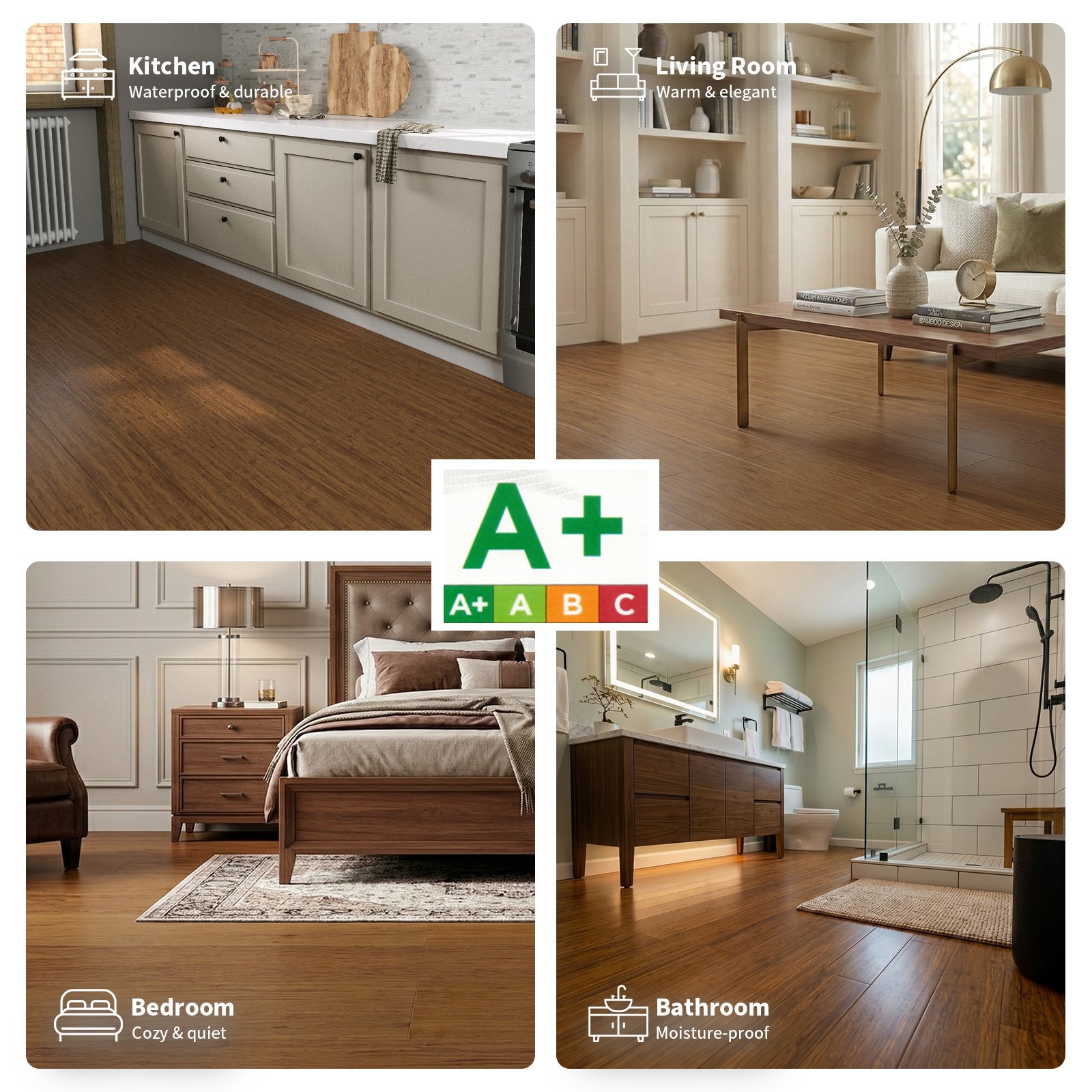
How strand-woven is made — and why it’s a different material
Strand-woven isn’t milled; it’s manufactured. Bamboo culms are crushed into fiber bundles, carbonized under heat, impregnated with resin, and cured under high pressure into a board with no visible nodes. The result has a density around 1,200 kg/m³ — roughly 1.5× that of ordinary bamboo — and behaves closer to a dense tropical hardwood than to traditional bamboo.
3. The Sustainability Story, With the Numbers
Three facts do the work here:
- Speed. A moso culm reaches full height in a single growing season (some growth of over 100 cm per day has been recorded), then spends 2–4 years hardening. Peak structural quality lands around year 5–6.
- Regeneration. Harvesting cuts the culm above the rhizome network — the plant survives and sends up new shoots the following year. No replanting, no bare soil.
- Substitution. Every square meter of bamboo displaces demand for slow-growing timber.
4. Formaldehyde & Indoor Air: The Standards That Actually Protect You
Bamboo itself doesn’t off-gas formaldehyde — the adhesives do. That’s why the construction and the certifications matter more than the raw material. Three names to know:
| Standard | What it limits | Limit | Who verifies |
|---|---|---|---|
| CARB Phase 2 | Formaldehyde emission | ≤ 0.05 ppm | California law; de facto US national standard (also federal TSCA Title VI) |
| FloorScore | 35+ VOCs including formaldehyde | CA Section 01350 criteria (~0.016 ppm formaldehyde) | SCS Global Services, independent |
| GREENGUARD Gold | 360+ VOCs, strictest limits | ~0.006 ppm formaldehyde | UL; aimed at schools & healthcare |
For context: outdoor ambient air itself contains trace formaldehyde, and OSHA’s workplace permissible level is 0.30 ppm — 6× the CARB Phase 2 limit.
5. Is Bamboo Flooring Waterproof? The Honest Answer
No wood-based floor is waterproof, and anyone selling you “100% waterproof bamboo” is stretching the truth. What’s actually true is this:
| Exposure | What happens | Verdict |
|---|---|---|
| Spill wiped up within minutes | No effect on a sealed floor | ✓ Fine |
| Damp mopping (well-wrung mop) | No effect if no water pools at joints | ✓ Fine |
| Standing water (leak, pet accident overnight) | Swelling, cupping, joint damage | ✕ Never |
| Steam mop | Forced vapor penetrates seams and breaks down finish | ✕ Never |
Two layers of protection determine real-world performance:
- The finish. Multi-layer UV-cured coatings (e.g. an 8-layer wear coat) seal the surface so spills sit on top long enough to wipe away.
- The core. Resin-impregnated strand-woven bamboo is by far the most moisture-tolerant construction — which is why it’s the recommended choice for kitchens, basements, and coastal homes. Click-lock profiles with tight joints also keep surface water out of the seams longer than old-style tongue-and-groove.
And one quirk almost no guide mentions: bamboo moves along its length. Wood barely changes length with humidity, but bamboo does — installers must leave expansion space at board ends, not just the sides. Keep indoor humidity between 35% and 55% and the floor stays flat.
6. How Durable Is Bamboo Flooring Really? (Hardness ≠ Scratch-Proof)
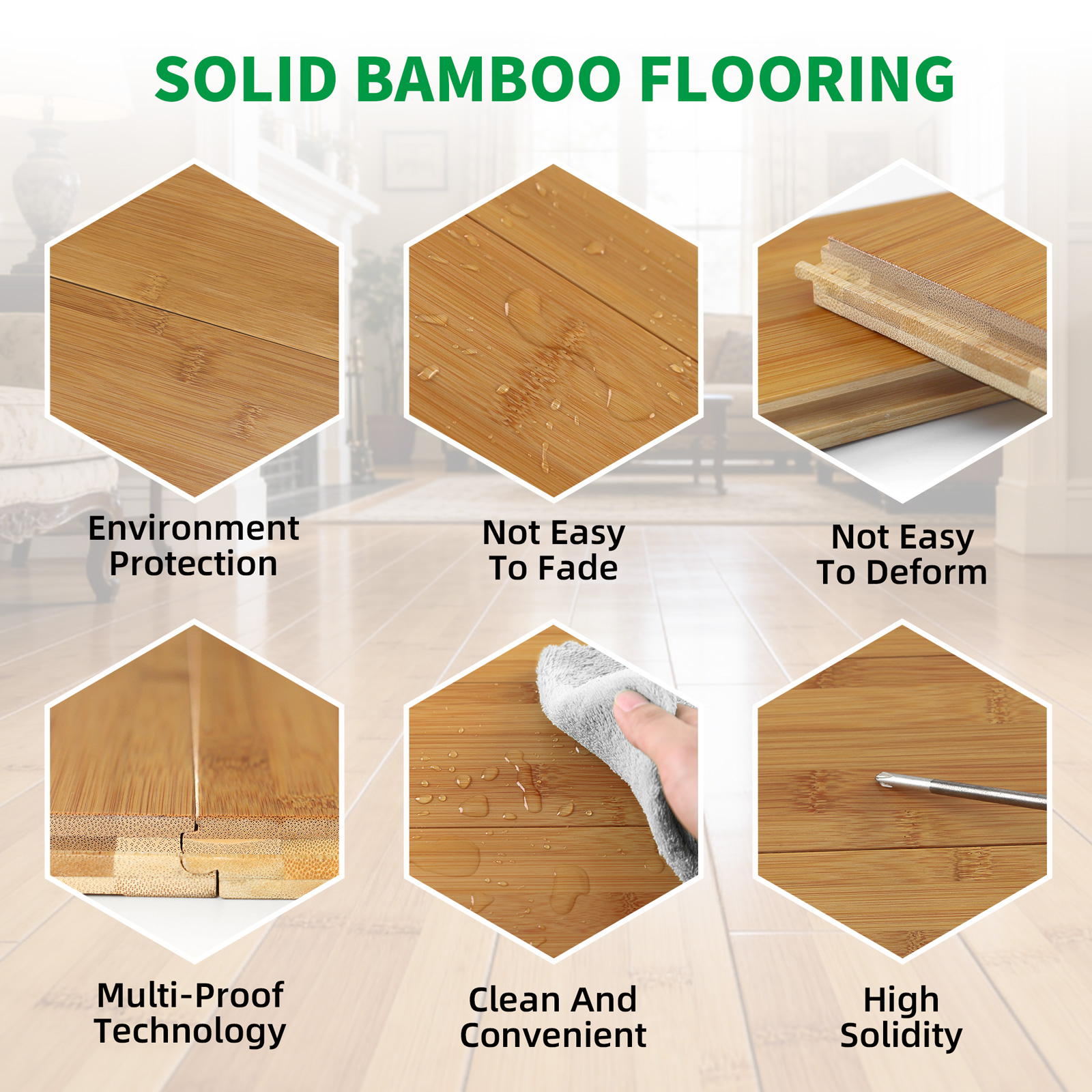
Janka measures resistance to a point load (a dent). It says nothing about three other things that actually wear a floor out:
- Surface wear — measured by Taber abrasion testing (revolutions until the coating wears through). A commercial-grade rating is 10,000+ revolutions; that’s what separates a floor that survives a hallway from one that doesn’t.
- Gouges — bamboo’s strength sits in its long fibers, but the tissue between them is weaker. A sharp rock under a shoe can gouge bamboo more deeply than oak with the same Janka rating. A doormat at every entrance costs nothing and prevents most of it.
- Finish scratches — pet claws and dragged furniture mark the coating first. Matte and mid-tone finishes hide this far better than high-gloss dark floors.
7. How to Clean Bamboo Flooring (The Complete Manual)
This is the most-asked bamboo question in the US by a wide margin — and most answers online are wrong in one dangerous way: they recommend steam mops. Don’t. Here’s the routine that keeps a bamboo floor alive for 25 years instead of 10.
The daily-to-weekly routine
- Dust-mop or vacuum with a hard-floor setting (beater bar OFF) every few days — grit is the #1 finish killer
- Damp-mop with a well-wrung microfiber mop — the mop should feel almost dry
- Use a pH-neutral wood-floor cleaner, or a drop of dish soap in water for light soil
- Wipe spills immediately with a dry or barely damp cloth
- Felt pads under every furniture leg; doormats at every entrance
- Steam mops — vapor forces moisture into seams and voids most warranties
- Wet mopping or spraying water directly on the floor
- Ammonia, bleach, vinegar solutions, and abrasive scrubs — they dull or strip the finish
- Oil-based “shine” products — they build up a film that attracts dirt and can’t be recoated over
- Wax on a prefinished floor
Deep cleaning, streak-free
When the floor looks dull even after mopping, it’s usually cleaner residue, not dirt. Mop once with pH-neutral cleaner, then mop a second time with clean well-wrung water only, and finish with a dry microfiber pass. Work in the direction of the planks. For white haze or sticky spots, a lightly damp cloth with plain warm water and immediate drying does more than any product.
Cleaning by mess type
| Mess | Method |
|---|---|
| Dust & grit | Dry dust mop / vacuum, hard-floor head |
| Drinks, pet accidents | Blot immediately, wipe with damp cloth, dry |
| Grease / kitchen film | pH-neutral wood cleaner, damp microfiber |
| Scuff marks (shoe soles) | Robbing with a tennis ball or a dry cloth — never steel wool |
| Sticky residue | Damp cloth + mild soap, wipe dry right after |
| White haze | Clean-water second pass + dry buff |
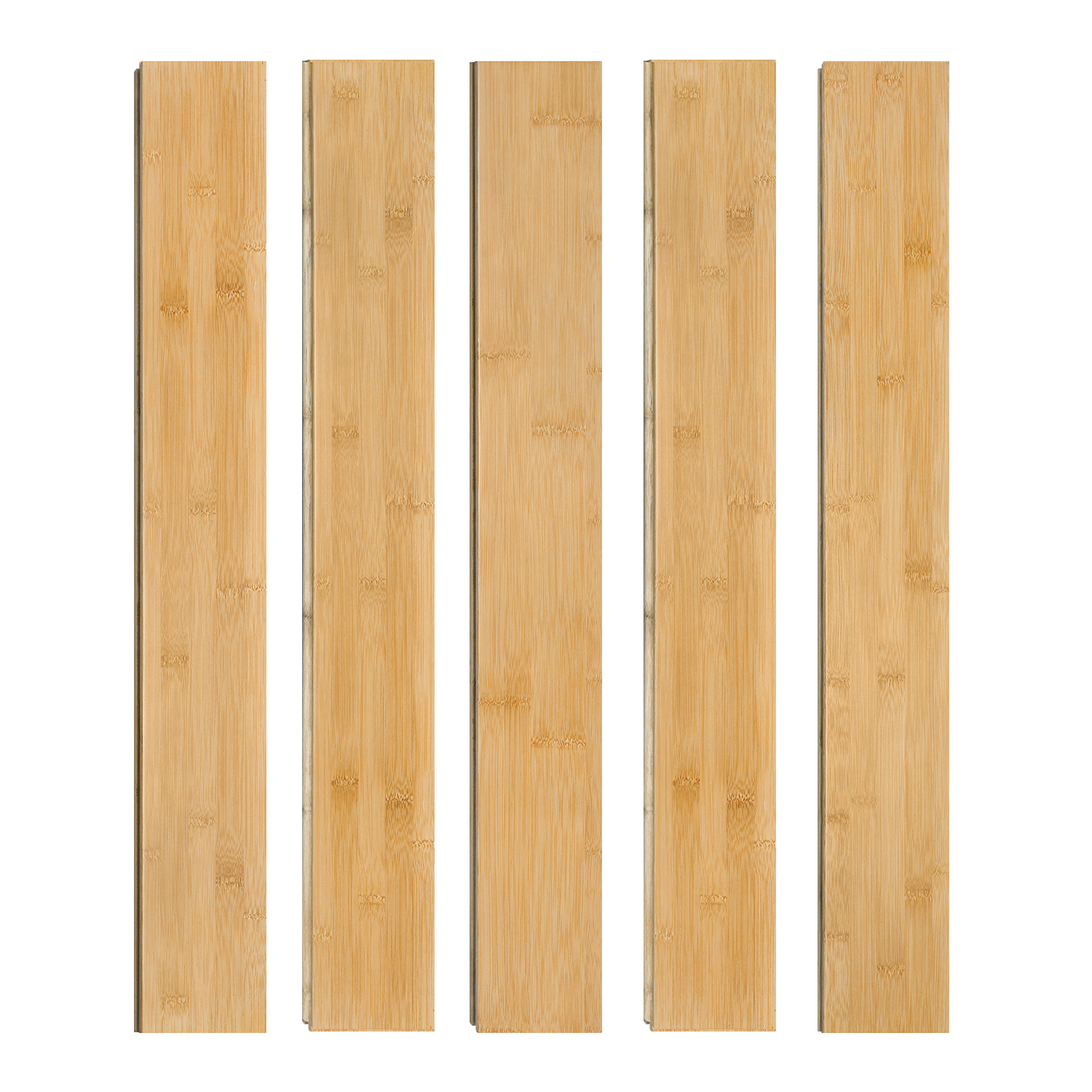
8. Can You Refinish Bamboo Floors? Yes — Here’s When and How
Refinishing is the quiet superpower of bamboo over laminate and vinyl, and it’s why “can you refinish bamboo floors” is searched tens of thousands of times a year. The short answer: yes, if the plank has enough material.
| Construction | Refinishable? | Typical times |
|---|---|---|
| Solid bamboo, 15 mm | ✓ Yes | 1–3 sand-and-reseal cycles over its life |
| Strand-woven (resin-rich) | △ Difficult | Professionally possible 1–2×; very hard on sanding equipment |
| Engineered, wear layer ≥ 3 mm | △ Maybe | 1× if the wear layer is thick enough |
| Engineered, thin wear layer / laminate | ✕ No | Replace when worn |
Signs your floor is ready: widespread dullness that cleaning can’t fix, scratches through the finish into the material, or sun-faded patches. Signs it’s not: cupping, lifting joints, or moisture damage — those need board replacement, not sanding.
The process, briefly: screen with a fine grit (a “screen and recoat”) if only the finish is worn — this is cheap, fast, and doesn’t remove material. Full sanding down to bare bamboo is a job for a pro familiar with bamboo, because strand-woven in particular is brutal on equipment. After sanding, reseal with 2–3 coats of a water-based polyurethane.
9. How to Install Bamboo Flooring: Floating vs Glue vs Nail
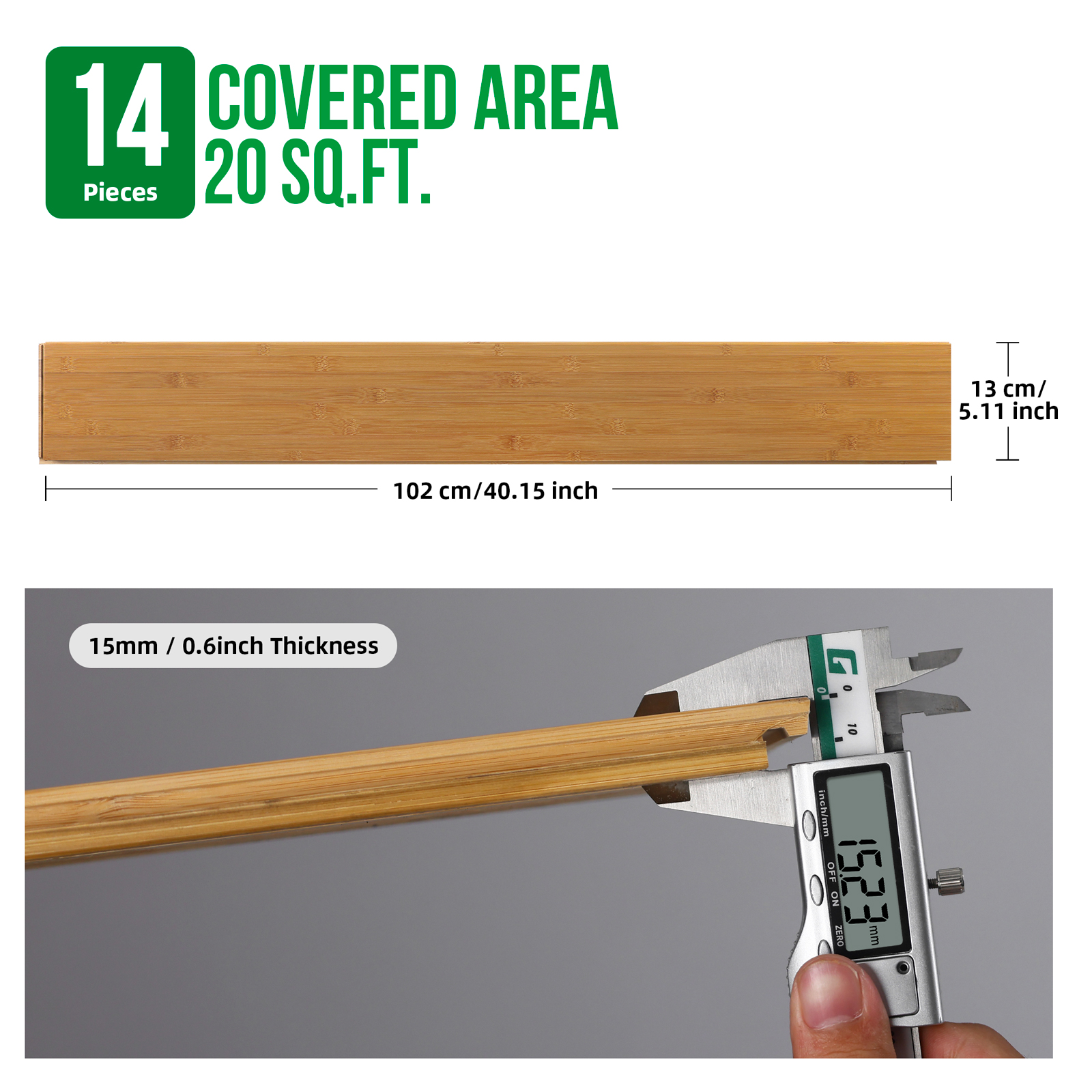
| Method | Skill needed | Best for | Notes |
|---|---|---|---|
| Floating click-lock | Beginner DIY | Concrete slabs, apartments, DIYers | Foam underlayment only; reversible; ~100–150 sq ft in an afternoon for a first-timer |
| Tongue & groove (nail/staple) | Intermediate | Plywood subfloors, whole-house | Most traditional feel; needs a flooring nailer |
| Glue-down | Pro recommended | Commercial, radiators/slabs | Bonded feel, no hollow sound; adhesive choice matters for VOCs |
- Acclimate the sealed boxes in the installation room for 48–72 hours
- Keep indoor humidity 35–55% — before and after installation
- Leave expansion gaps at walls and at board ends (bamboo moves along its length)
- Level the subfloor first — click-lock joints telegraph bumps along the row
- Order 7–10% extra for cuts and waste
- Bring radiant heating up to temperature gradually over several days
10. Bamboo Flooring Cost: What You’ll Actually Pay in 2026
| Item | Typical US range (published) |
|---|---|
| Solid bamboo (material) | $3–$5 / sq ft |
| Strand-woven bamboo (material) | $4–$7 / sq ft |
| Engineered bamboo (material) | $4–$8 / sq ft |
| Professional installation | $3–$6 / sq ft |
| 400 sq ft room, strand-woven, installed | ≈ $2,800–$5,200 |
Published industry ranges, 2026. Jeedeson’s own cases run $39–$159 per 20 sq ft case (≈ $2–$8 / sq ft) — check each product page for the current case price.
Formaldehyde limits for composite wood products are regulated under California CARB’s Composite Wood Products program — the reference authority for the limits in the table above.
1. Is Bamboo Flooring a Hardwood? (No — It’s a Grass)
| Strand-woven bamboo | Solid oak | |
|---|---|---|
| Janka hardness | 3,000–4,000+ lbf | 1,290 (red) / 1,360 (white) lbf |
| Time to replace raw material | 5–7 years, regrows | 40–60 years |
| Refinishing cycles | 1–2× (difficult) | 3–5× |
| Moisture tolerance | Moderate (best in resin-impregnated form) | Moderate |
| Material cost | $3–$7 / sq ft | $4–$12+ / sq ft |
| Lifetime | 20–30 yrs | 30–100 yrs (with refinishing) |
The honest summary: hardwood wins on longevity and refinishing; strand-woven bamboo wins on dent resistance, renewability speed, and price. For most busy family homes, that trade favors bamboo.
12. Bamboo Flooring Pros and Cons — The Unedited List
13. Which Jeedeson Floor Fits Your Room
| Room / situation | Recommended construction | Series |
|---|---|---|
| Living rooms, bedrooms, studies, hallways | Click-lock floating, solid 15 mm | Water-Resistant Click Lock, 5.12″ wide plank or 3.78″ narrow plank |
| Pets, kids, high traffic, commercial | Strand-woven carbonized | Strand Woven, Coffee, commercial grade |
| Whole-house, refinishable floor | Solid tongue & groove 15 mm | Horizontal T&G, 3.78″ · Solid 5.11″, Gloss 30 |
| Low-reflection, hides dust & scuffs | Matte finish solid | Matte, Gloss 10 wide plank |
| Warm dark tone, engineered look | Solid, embossed grain | Walnut Embossed |
FAQ
Is bamboo flooring good for homes with pets?
Strand-woven bamboo is one of the better choices: 3,000+ lbf Janka resists dents from claws and dropped objects, and a matte mid-tone finish hides fine scratches. No floor is scratch-proof — trim nails and use rugs at entrances.
Can you use a steam mop on bamboo floors?
No. Steam forces vapor into the seams and breaks down the finish, and it voids most manufacturers’ warranties. Use a well-wrung microfiber mop with pH-neutral cleaner instead.
How long does bamboo flooring last?
20–30 years or more with proper care. Solid 15 mm planks can be refinished 1–3 times, which extends life substantially.
Is bamboo flooring cheaper than hardwood?
Usually, yes — strand-woven runs $4–$7/sq ft versus $4–$12+ for comparable hardwood, and installation is the same or less.
Does bamboo flooring increase home value?
Like any well-installed hard-surface floor, it presents well to buyers, but appraisers treat it like other wood-look hard flooring rather than a premium exotic.
Can bamboo flooring go in a basement?
Strand-woven, or an engineered/click-lock construction over a moisture-tested slab, yes. Solid glue-down solid bamboo over damp concrete is the combination to avoid.
Why does my bamboo floor look hazy after cleaning?
Cleaner residue. Mop a second time with clean, well-wrung water and dry-buff with a microfiber cloth. Avoid oil-based shine products, which cause the buildup in the first place.