 Jeedeson Official Website




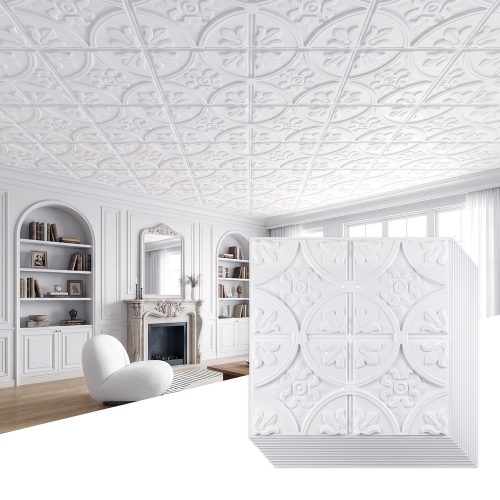
Small patterns disappear on a ceiling, because you are looking at them from 8 ft away at an angle. This tile is built the other way: one large palmette bloom fills the panel, with scalloped corners that open toward the edges, so a run of them reads as a ceiling of big blossoms rather than a fine texture. Twelve per case, 47.28 sq ft, matte white PVC, drop-in or glued.

A Large-Scale Floral That Reads at a Distance
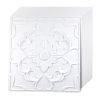
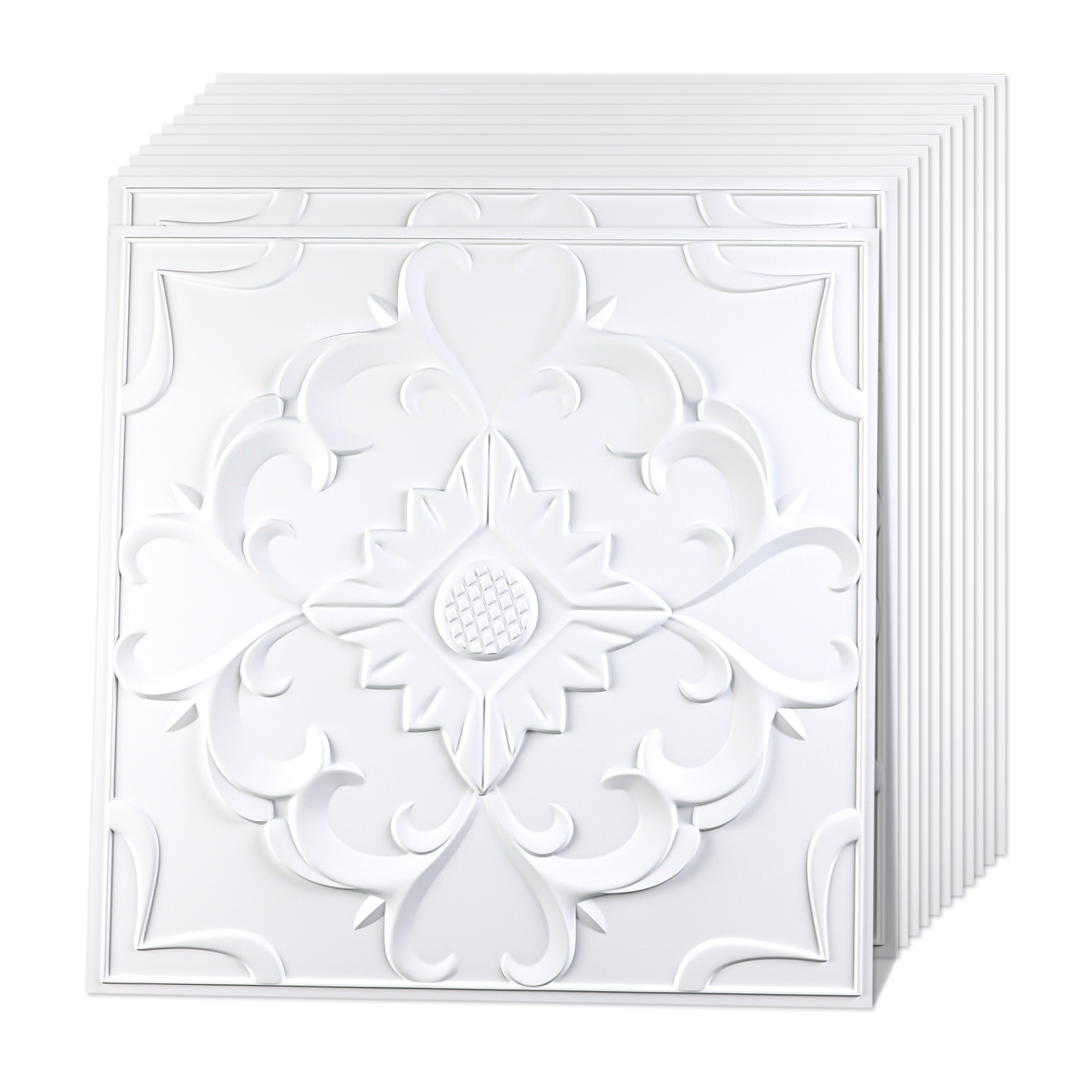
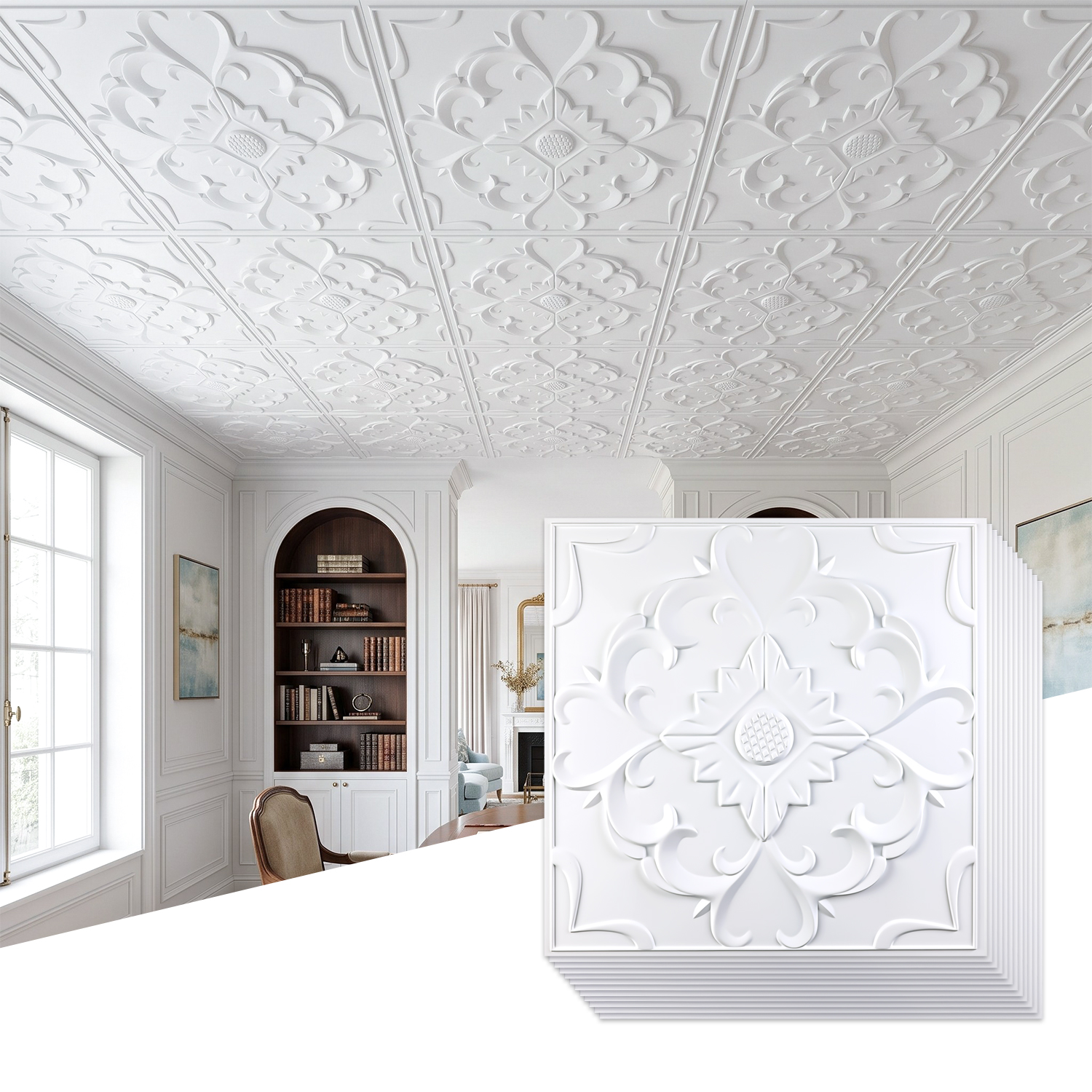
The motif is a single fan-shaped bloom, roughly 16 in. across, set in a shallow frame with quarter-round corners. Because the scale is large, the pattern survives the distance between the floor and the ceiling, which is where most 3D tiles lose their definition.
It is also a calmer pattern in a busy room than a dense medallion. One bloom per tile gives the eye a single shape to land on, and the scalloped corners create a soft wave along the tile joints rather than a hard grid.
- One large bloom per panel, about 16 in. across
- Scalloped corners soften the tile joints
- Reads clearly from floor level
What One Case Covers
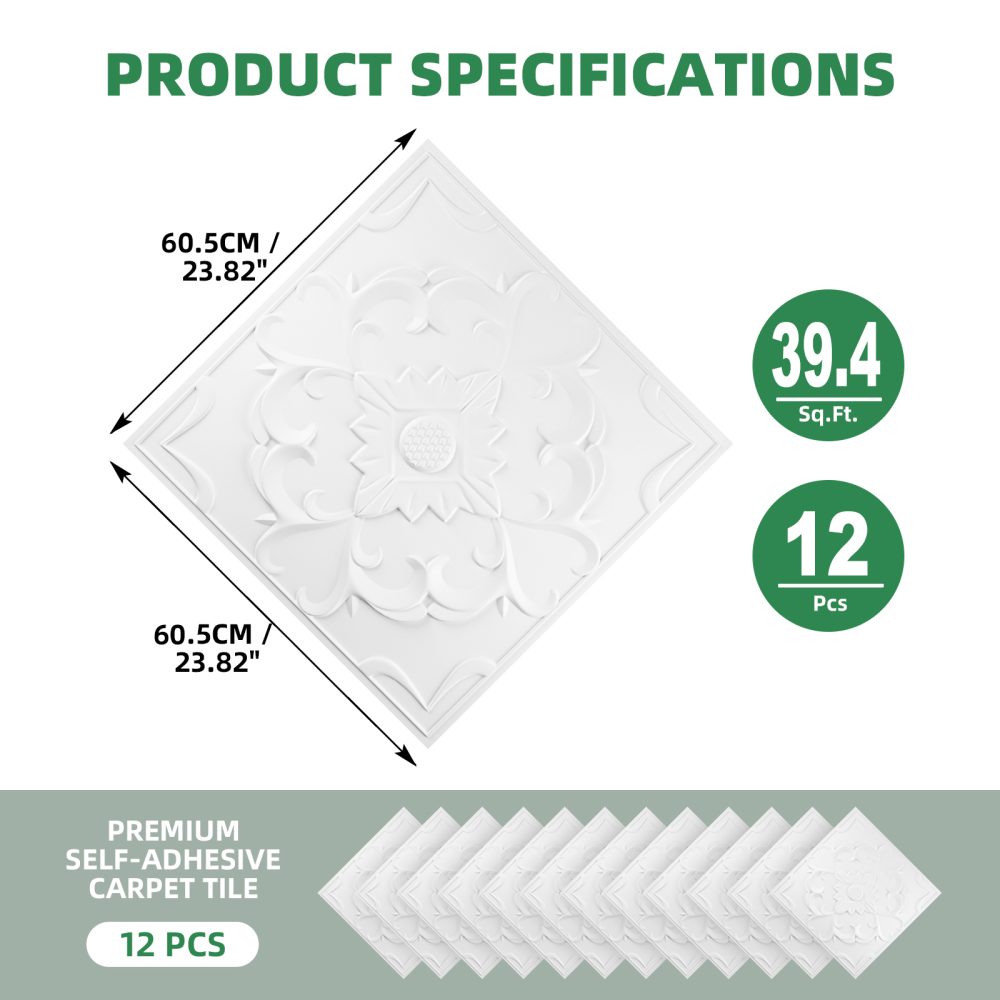
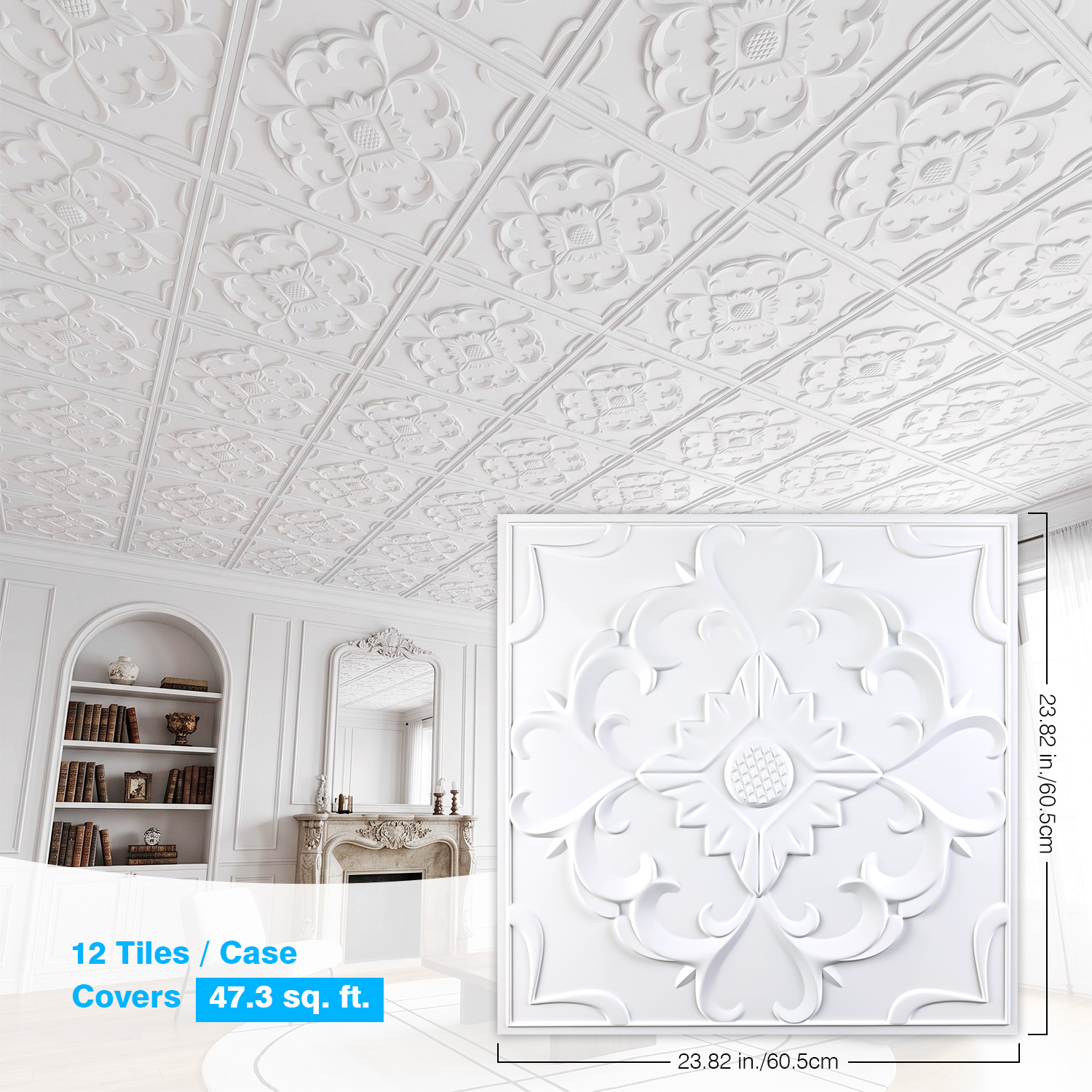
Twelve tiles at 3.94 sq ft each is 47.28 sq ft, a 6.9 x 6.9 ft area with no cuts. Add 10 percent for the perimeter row: a 10 x 10 ft ceiling takes three cases, a 12 x 12 ft ceiling takes four.
On a suspended ceiling, count the panels you are replacing instead of measuring the floor. The two numbers usually differ by a tile or two, and the grid is what the tile has to fit.
- 47.28 sq ft per case
- 3.94 sq ft per tile, simple to divide by
- Three cases for a 10 x 10 ft ceiling
Drop-In Ceiling Installation
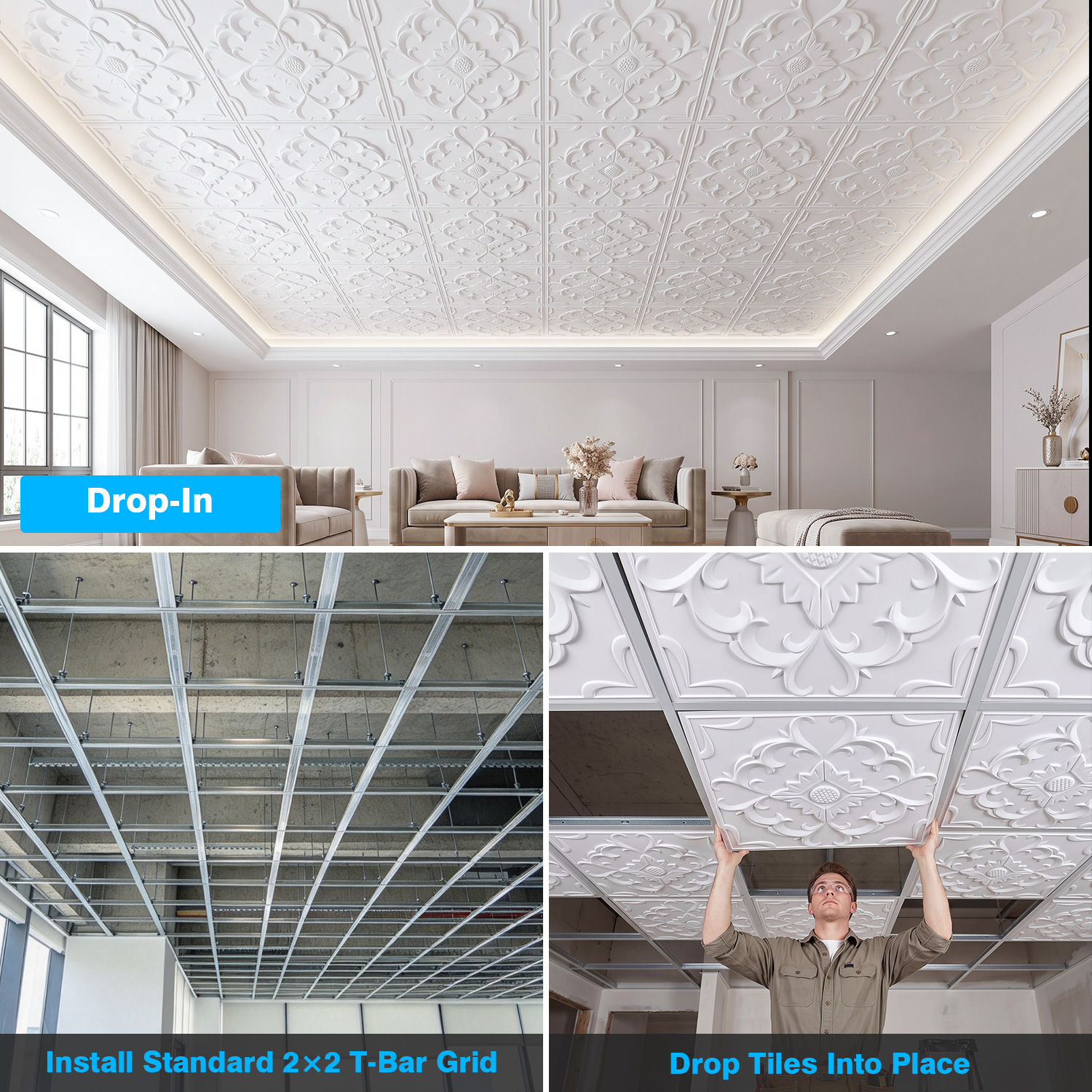
These are lay-in panels for a standard 15/16 in. exposed T-bar grid with 2 x 2 ft openings. The square edge rests on the flange, the panel needs no clips, and it lifts out again for access to wiring or ducts.
Lay the first few and step back. Because the bloom is large, a run of tiles that drifts out of line reads as a wobble across the ceiling rather than a crisp row, so check the pattern line against the wall every third tile.
- Fits 2 x 2 ft openings in a 15/16 in. grid
- No fasteners, lifts out for service
- Check pattern alignment every third tile
Glue-Up Installation
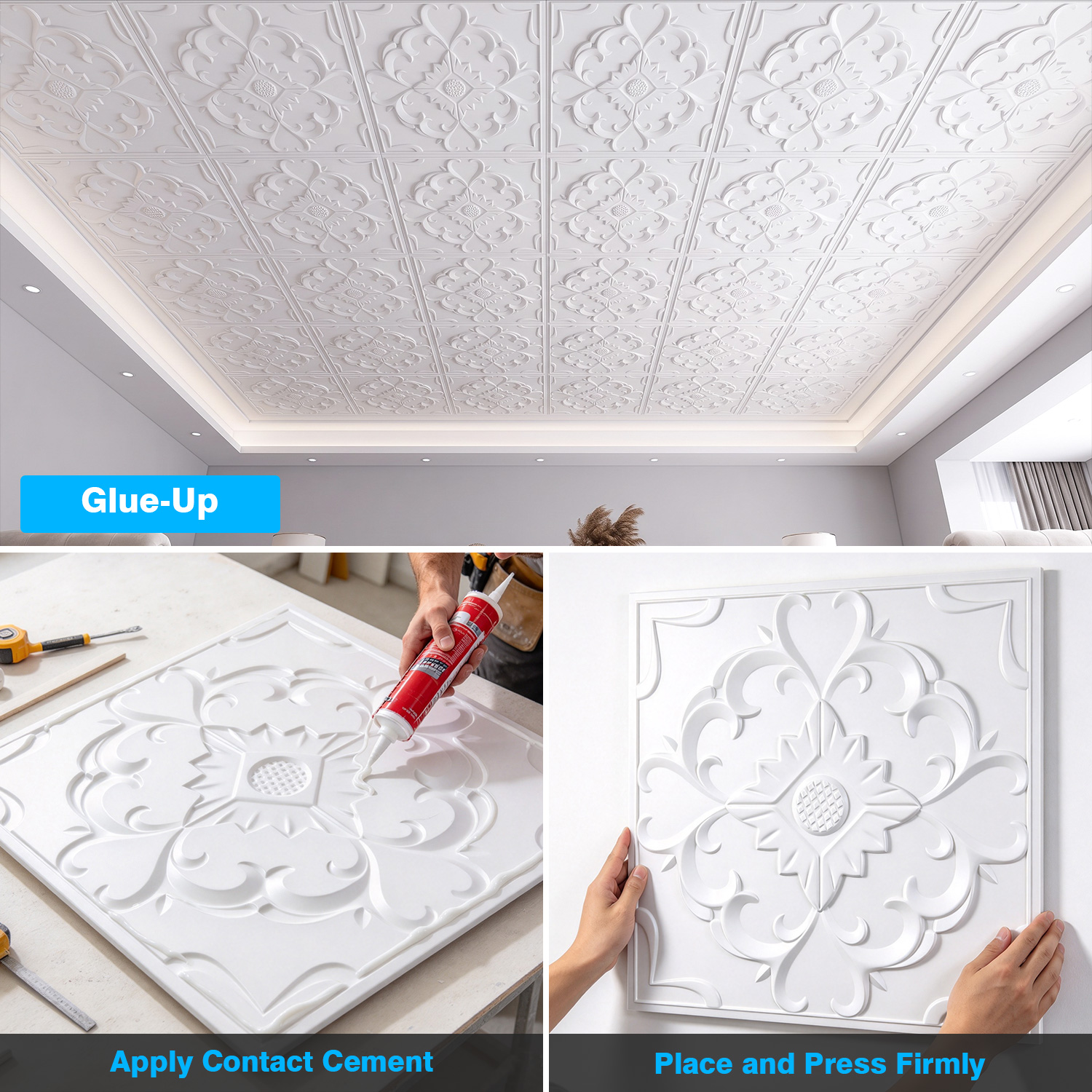
On drywall or plaster the panel goes up with contact cement: coat the back and the ceiling, let both go tacky, press and hold. The grab is immediate, so set the first row against a chalk line and check it before it touches the ceiling.
Cut tiles belong at the perimeter. A bloom that is cut through the middle looks like a mistake, while a bloom cut by a wall looks intentional, which is the same rule a tiler uses with a large-format floor tile.
- Contact cement on both faces
- First row against a chalk line, checked before contact
- Keep cut blooms at the perimeter
The PVC Face and What It Handles
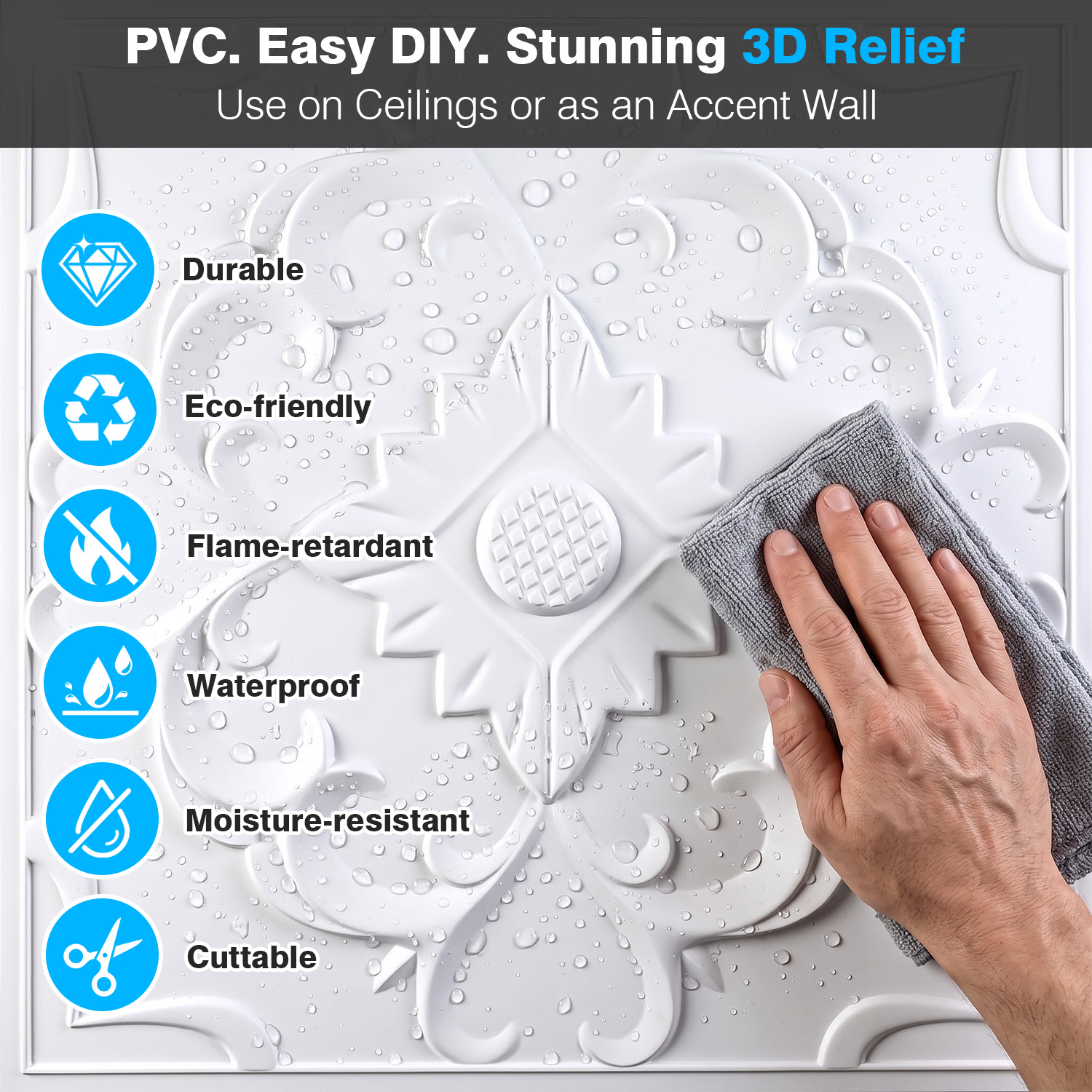
The panel is rigid PVC with a matte white finish: no rust along a cut edge, no denting when a ladder touches it, no repainting to stay white. A damp cloth takes off kitchen grease, and the matte face hides the small unevenness of an old ceiling.
It is light enough to handle alone. A full case weighs 13.23 lb, and one panel stays flat against the adhesive while it cures instead of peeling away at a corner.
- Rigid PVC, matte white, no rust or denting
- Waterproof, moisture resistant, flame-retardant
- 13.23 lb per case
Living Rooms, Porches and Sunrooms
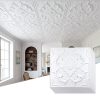
The large bloom suits rooms where the ceiling is part of the look: a living room with a fireplace, a covered porch ceiling, a three-season sunroom, a dining room in an older house. In each case it adds detail without the density of a medallion pattern.
It is less suited to a small utility room or a closet, where the pattern is wasted, and it should stay indoors. This is a finished interior panel, not exterior cladding.
- Living rooms, porch ceilings, sunrooms, dining rooms
- Pattern is wasted in closets and utility spaces
- Indoor use only
Cutting Around Beams and Fixtures
Score the face twice with a utility knife, bend the waste away and cut the fold. For a recessed light, mark the circle on the back of the panel, cut slightly inside the line and let the trim ring cover the edge.
Where a beam interrupts the ceiling, cut the tile to the beam and start a new field on the other side. Do not try to continue the bloom across a beam; the pattern reads as broken rather than continuous.
- Score and snap with a utility knife
- Cut light openings from the back, 2 mm tight
- Start a new field on the far side of a beam

Three Checks Before Ordering
Grid spacing first: 2 x 2 ft openings with 15/16 in. tees. Second, the border: plan which edge the cut row sits against, because a cut bloom at the wall looks right and a cut bloom in the middle does not.
Third, the ceiling itself if you are gluing: it has to be clean, dry and sound, with no flaking paint. Contact cement bonds to what is there, and if what is there is loose, the tile comes down with it.
- Confirm 2 x 2 ft grid spacing
- Decide the cut edge before you start
- Gluing needs a sound, clean, dry ceiling
Product Specifications
- SKU: JDS23-CT233
- Tile Size: 23.62 x 23.62 in. (60 x 60 cm)
- Relief Depth: 12 mm (0.47 in.)
- Quantity: 12 tiles per case
- Coverage: 47.28 sq ft (4.39 mm²)
- Colour: Matte White
- Material: PVC
- Installation: Lay-in 15/16 in. T-bar grid or glue-up
- Edge: Square edge
- Feature: Palmette floral relief, waterproof, cuttable
- Package Includes: 12 ceiling tiles
- Net Weight: 13.23 lb (6 kg) per case
- Care: Damp cloth and mild soap
- Not suitable for: Outdoor use and direct water contact
If you need a different pattern or a larger quantity, feel free to contact us.
Frequently Asked Questions
Is the pattern big enough to see from the floor?
Yes, that is the point of this design. The bloom is roughly 16 in. across on a 23.62 in. tile, so it reads as a shape from 8 ft below rather than a fine texture. Small medallions blur at that distance.
How many cases for a 12 x 12 ft room?
Four cases, which is 189 sq ft against 144 sq ft of ceiling. The surplus covers the perimeter cuts and a couple of spares.
Do these fit a standard drop ceiling?
They are sized for 2 x 2 ft openings in a 15/16 in. exposed T-bar grid, the most common residential grid in the US. Measure between tee centres: 24 in. is lay-in, 48 in. needs a cross tee first.
Can they be glued directly to drywall?
Yes, with contact cement or a heavy-duty construction adhesive. The ceiling must be clean, dry and sound. Flaking paint has to come off, because the adhesive bonds to the paint rather than the plaster.
Do the tiles need to line up in a particular direction?
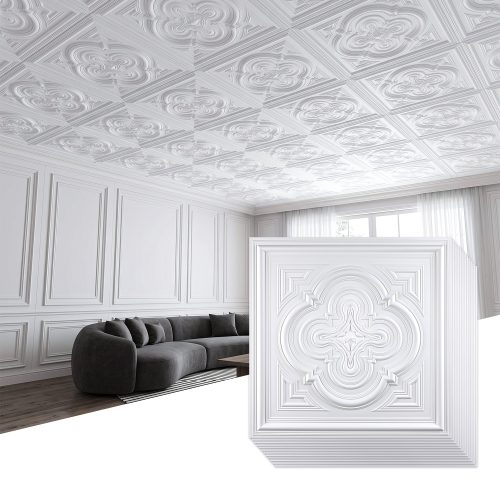
The bloom is upright, so keep every tile turned the same way. A tile rotated 90 degrees reads as a broken pattern, unlike the symmetric quatrefoil in this range.
Can I paint them?
Yes. Scuff the face lightly, wipe off the dust and apply water-based paint in two thin coats. Thick coats fill the relief and the bloom goes flat.
Are they suitable for a porch ceiling?
A covered porch is fine: PVC does not absorb water and will not rust or swell. An open porch that takes driving rain is not, because this is an interior panel.
Questions About This Ceiling Tile?
Tell us the room size, the ceiling height and whether you already have a grid, and we will tell you how many cases you need before you buy.


Reviews
There are no reviews yet.