 Jeedeson Official Website
Is bamboo flooring durable? Yes — but only if you know which bamboo you are buying. A strand-woven plank tests around 3,000 lbf on the Janka scale against red oak’s 1,290. A carbonized horizontal plank tests 1,180, which is softer than oak. Same plant, opposite answer. Below is what eight years of kids, dogs and spilled juice actually does to a bamboo floor, and which of our seven planks survives which room.
Is Bamboo Flooring Durable?
What 8 Years in Real Homes Shows
The hardness numbers, the scratch myth, the water limit nobody mentions — and the exact plank to pick for a house with dogs, kids, or both.
📋 What this guide covers
- The three constructions, and why only one is genuinely hard
- 8 years of kids, dogs and juice — what the floor actually looks like
- Does bamboo flooring scratch? The dent-vs-scratch distinction
- The water limit, and the 10-second spill test
- How long bamboo flooring lasts, and how often it can be refinished
- Which of our seven SKUs to buy for which room
The 30-second answer
Is bamboo flooring durable? Strand-woven bamboo is genuinely durable — harder than oak, refinishable, good for 20–25 years. Horizontal and carbonized-strip bamboo is an oak-class or below-oak floor, and should not be sold to you as a tough option.
Bamboo flooring durability is therefore not a yes-or-no question. It is a question about which plank — and this guide answers it with numbers rather than adjectives.
1. Bamboo flooring durability starts with one word: construction
Bamboo is a grass. That fact gets used to imply “soft”, which is both true and irrelevant — the finished plank is bamboo fibre compressed with resin under heat, and how you compress it decides everything. Three constructions reach the market, and they do not perform alike:
Two things worth stating plainly, because most bamboo pages won’t. Note also that strand woven bamboo flooring (often written with a hyphen) is the only construction on that list which clears oak by a wide margin — the rest sit at or below it.
1. “Harder than oak” is a marketing sentence, not a spec. Roughly half of all hard flooring clears that bar. The only useful question is: which construction, and what Janka figure?
2. Carbonizing is a colour process, not a strength process. It caramelises the sugars in the bamboo and darkens it toward coffee. It also lowers hardness by around 20% on the same construction — which is why “carbonized” alone tells you nothing about durability.
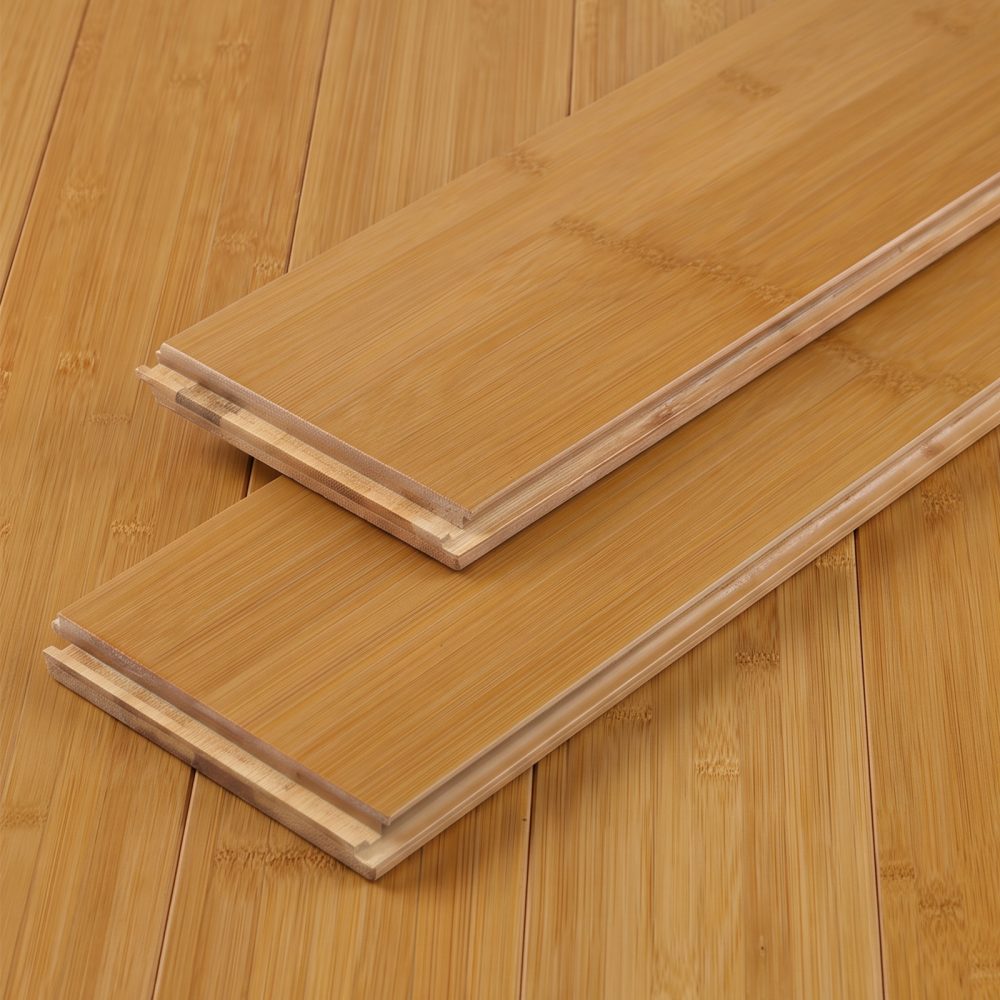
Solid bamboo runs bamboo through the full thickness — that is what makes refinishing possible later.
2. Eight years of kids, dogs and spilled juice
The most useful thing we can show you is not a lab report. It is a floor that has been lived on — because whether bamboo flooring is durable in your house depends on your house, not on a test rig. This is our own install after eight years of children, dogs and the occasional juice glass going over:

And where a bamboo floor begins — a culm, cut and pressed into a room. Worth watching once if you have ever wondered what you are actually buying:

What eight years actually shows: the wear is almost entirely in the finish, not in the material. The floor under a doorway shows a dulled patch where grit gets walked in. The floor under a dining chair shows a faint ring. Nothing has dented through, and nothing has delaminated — because a 15 mm solid plank has bamboo all the way down, not a 2 mm veneer over a soft core. That is what a durable bamboo floor looks like when it is built right.
The rule that matters: with bamboo flooring, durability is 70% construction, 20% finish, and 10% how you treat it. A cheap horizontal plank with a thin coat will look tired in five years. A strand-woven plank with a multi-layer finish will still be going at twenty.
3. Does bamboo flooring scratch? Dents and scratches are two different tests
This is where most buyers get led astray, so it is worth being precise. The Janka test measures dent resistance: a steel ball is pressed into the board and the force recorded. It does not measure scratch resistance at all. Those are separate properties, and they fail in different ways.
A dent
A dropped pan, a chair leg, a stiletto heel. This is what Janka predicts — and where strand-woven bamboo genuinely wins at 3,000 lbf.
A scratch
Grit under a shoe, a dog’s claw, a dragged sofa. This is a finish question — aluminum oxide coatings are what resist it, not hardness.
So: does bamboo flooring scratch? Yes, like every finished wood-based floor. A small rock in a shoe can cut a bamboo fibre more readily than it cuts oak, because bamboo’s strength runs along the fibres while the tissue between them is weaker. But the everyday marks — claws, grit, chair legs — land on the coating, and a quality multi-layer aluminum oxide finish absorbs them for years.
What actually reduces scratches, in order of effectiveness:
- A matte or satin finish. Gloss reflects light and amplifies every fine mark. Gloss 10 hides what Gloss 30 highlights — see our gloss level guide.
- Mats at every exterior door. Tracked-in grit is the single biggest cause of finish wear, more than claws.
- Trimmed nails. A blunt edge spreads load; a sharp point concentrates it.
- Felt pads under every chair leg. Cheapest durability upgrade you will ever make.
4. Bamboo flooring with dogs: what survives, what doesn’t
If you are searching bamboo flooring with dogs, you probably want a yes or no. So does everyone weighing bamboo flooring for pets in general. Here is the honest version:
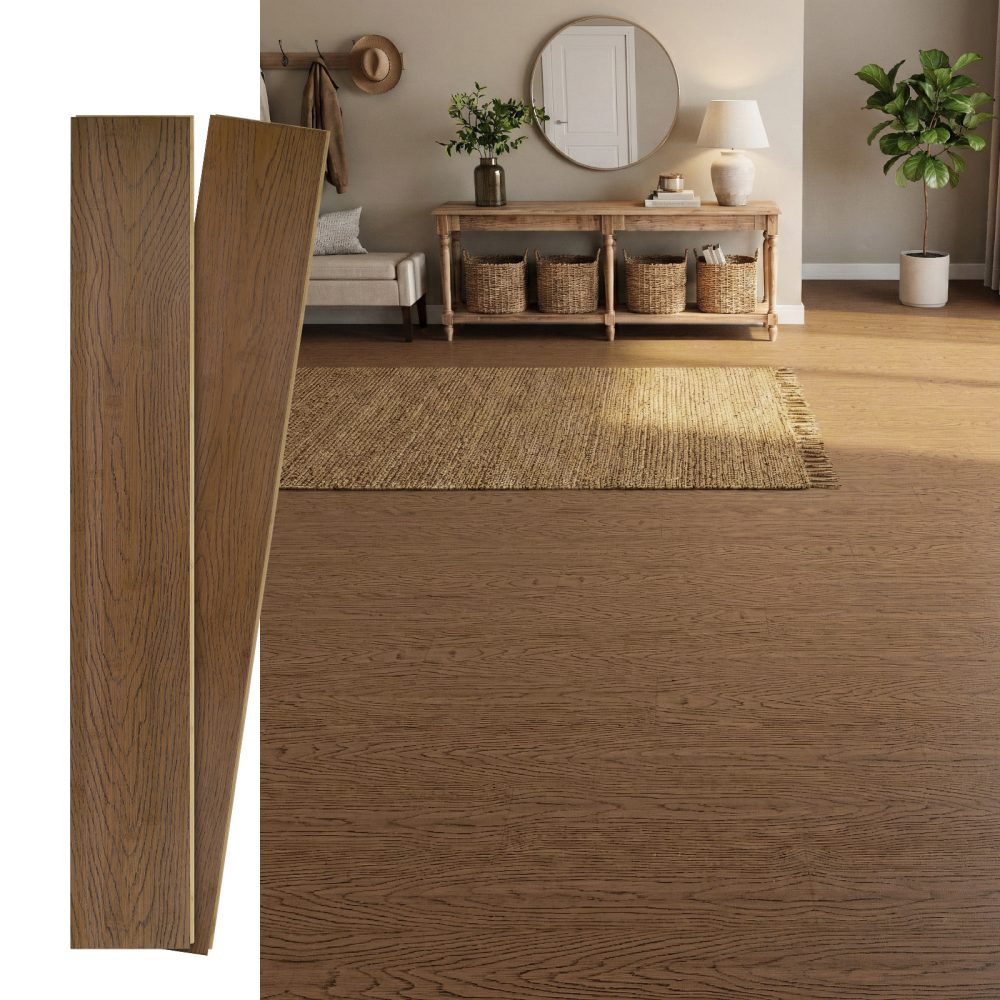
A solid bamboo floor in a family room — a matte finish hides claw marks far better than gloss does.
♻️ If you have a large dog and one choice to make
Buy strand-woven in a matte, mid-tone finish. Our JDS-JDB04G10 in Coffee is exactly that combination — dark enough to hide marks, matte enough not to announce them, hard enough not to dent.
5. Water is the real limit — what a 10-second spill test shows
Here is the part bamboo marketing tends to skip: bamboo is not waterproof. Neither is hardwood. So when people ask whether bamboo flooring is durable, the honest answer has a boundary — what separates a floor that survives a spill from one that cups at the seams is how long the water sits there, measured in minutes, not hours.

The practical protocol that keeps a bamboo floor intact:
Spill protocol
- Blot, don’t wipe. A damp cloth lifting water is fine; a wet mop pushing it into seams is not.
- Dry within minutes. A spill that is gone in five minutes leaves no trace. One left overnight can stain and swell an edge.
- No steam mops. Steam forces moisture past the coating and into the core. This is the fastest way to void a floor’s life.
- Keep indoor humidity between 30% and 50%. Bamboo moves with humidity more than most hardwoods, and it moves along its length — so a floor needs expansion room at the plank ends, not just the walls.
Where this rules bamboo out: full bathrooms, laundry rooms, and below-grade basements that take on water. If a room gets standing water, tile or a waterproof rigid-core product is the correct answer, not bamboo. Everything else — kitchens with a mat at the sink, entryways, bedrooms, living rooms — is fair game.
6. How long does bamboo flooring last?
Quality bamboo, correctly installed and kept in a normal indoor humidity range, runs 20 to 25 years. Strand-woven is at the top of that band; thin, cheap horizontal bamboo with a light coating can look worn in five to ten. The variable is not the plant. It is density, finish and installation.
The other half of the answer is refinishing. Solid bamboo carries bamboo through its full thickness, so it can be sanded and recoated once or twice over its life — which is what turns a 25-year floor into a 40-year one. A thin engineered bamboo veneer cannot be sanded; when the finish goes, the floor goes. If longevity is the goal, that difference matters more than any brochure claim:
Compare the two properly in our guide to solid vs engineered bamboo flooring, and the wider material comparison in bamboo vs wood flooring.
7. The seven planks, ranked by what they survive
All seven of our bamboo SKUs are solid bamboo at 14–15 mm. What changes is the construction and the surface — which is the whole reason bamboo flooring durability varies so much between products that look identical on a screen. Read this as a durability ranking for a busy house:
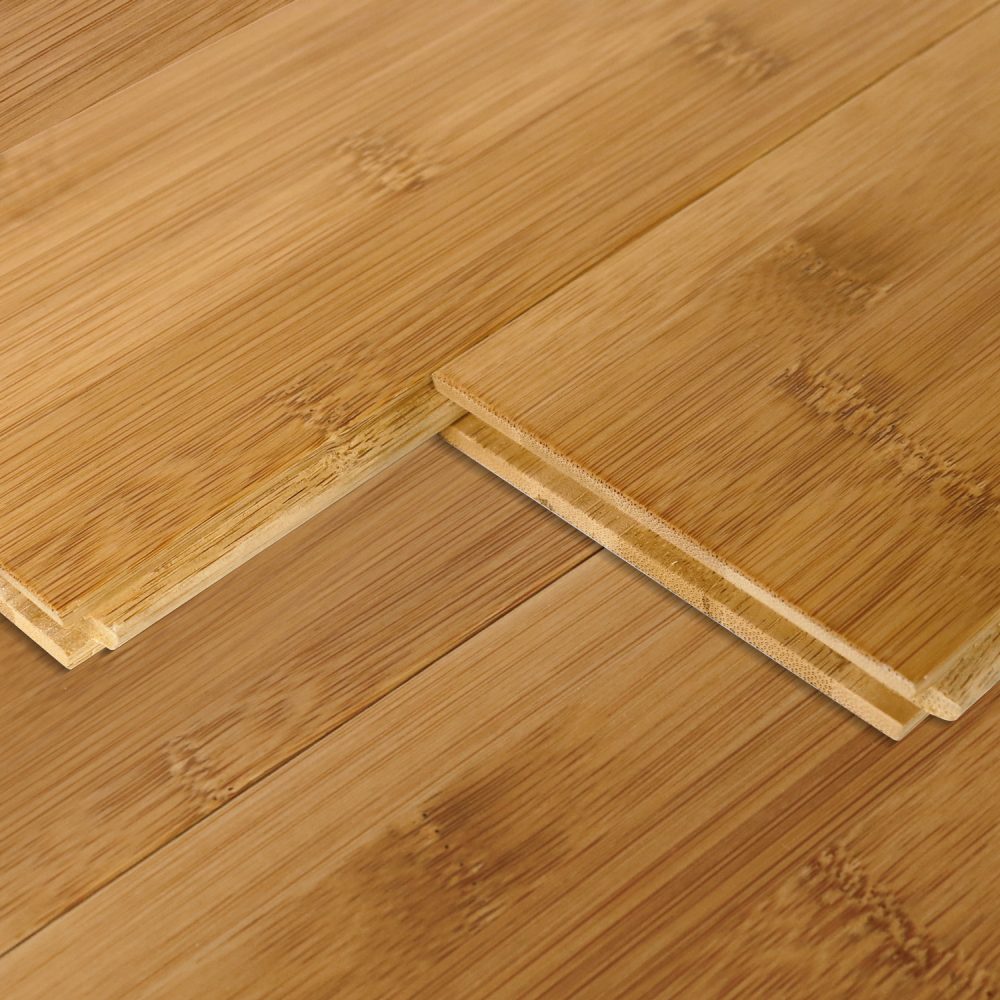
Click-lock bamboo: the floating format makes a single damaged plank replaceable years later.
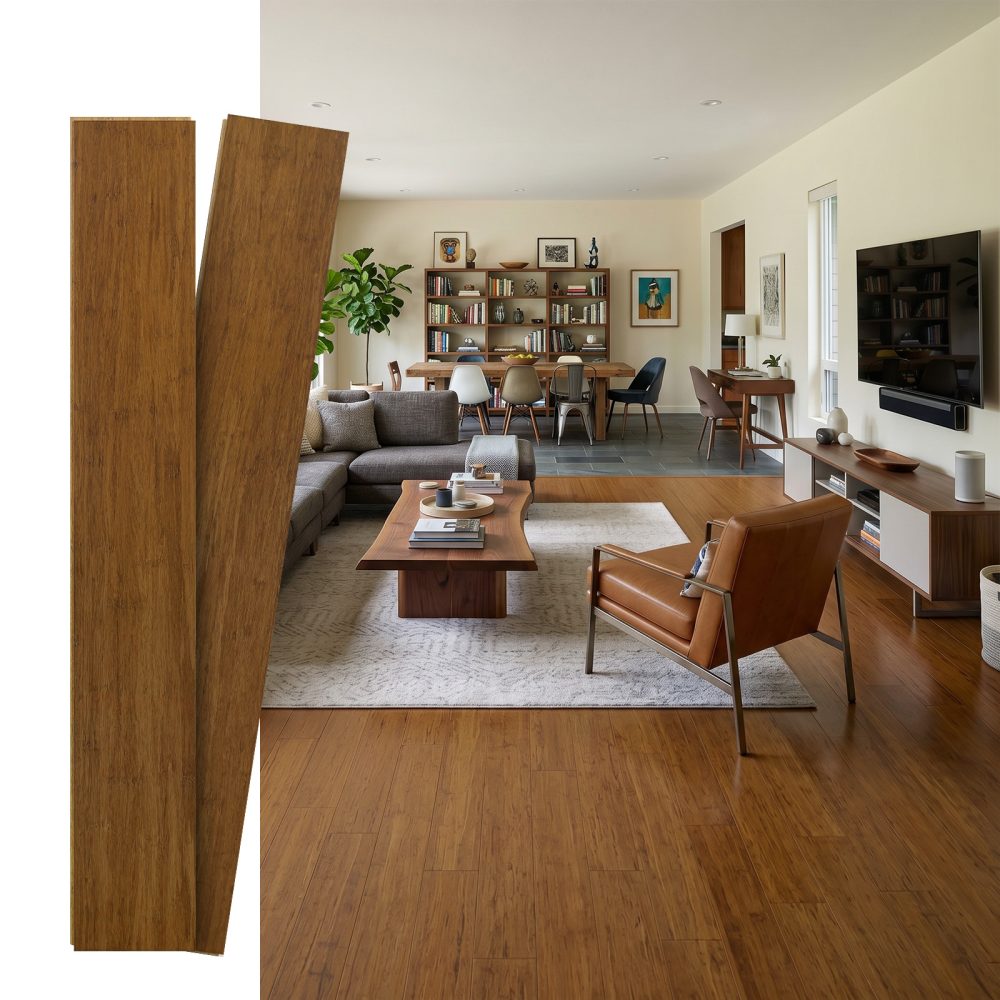
Carbonized strand-woven in Coffee — dark colour, matte surface, the hardest construction in the range.
8. Room by room: where bamboo holds up
Bamboo flooring durability is set by the room as much as by the plank. The same floor can be a 25-year investment in a bedroom and a mistake in a bathroom:
9. The questions people actually ask
Is bamboo flooring durable enough for a family with kids and a dog?
Yes, if it is strand-woven. At ~3,000 lbf it takes dropped toys and chair legs better than oak. Pair it with a matte finish and trimmed nails and it will outlast the mortgage.
Does bamboo flooring scratch easily?
It scratches like any finished floor — the marks land on the coating, not the bamboo. Matte finishes hide them; aluminum oxide coatings resist them. It is dents, not scratches, where bamboo’s construction really separates.
Can bamboo flooring be refinished?
Solid bamboo, yes — once or twice. Thin engineered veneer, no. That single difference is worth more years than any hardness number.
Is bamboo waterproof?
No. Water-resistant enough for spills wiped up in minutes; not for bathrooms or any room that floods.
How long does bamboo flooring last?
20–25 years typical for quality solid bamboo, longer with a refinish. Cheap horizontal bamboo with a thin finish is a five-to-ten-year floor.
New to the material altogether?
Start with what bamboo flooring is, then see the before-and-after installs and the cleaning and refinishing costs.
Sources
Hardness figures are Janka ratings as published for red oak (1,290 lbf), horizontal and carbonized bamboo, and strand-woven bamboo. Installation and moisture guidance follows NWFA practice; abrasion data for our strand-woven plank is measured to ASTM D4060 (Taber). Bamboo growth and renewal data from INBAR; indoor-air limits from EPA TSCA Title VI. Ratings vary by lot — ask for the figure on the product you are buying, not the category.
10. Watch the floors in real rooms
Every durability claim above is easier to judge on film than in a table. New installs and wear tests go up weekly:
Choosing by durability? Start with the hardest plank.
Strand-woven, matte, 18.3 sq ft per box. Add 10% for waste, round up to whole boxes, then use the code at checkout.
10% off the bamboo range · see all 7 bamboo floors
Short version: bamboo flooring durability comes down to construction and finish, not to the word “bamboo” on the box. Check the Janka figure, check whether the plank is solid through its thickness, and check the finish — then the floor will outlast the room’s decoration. Want the spec-by-spec version? Start with what bamboo flooring is and the cleaning, refinishing and cost guide, or read the pricing guide if budget is the deciding factor.