 Jeedeson Official Website
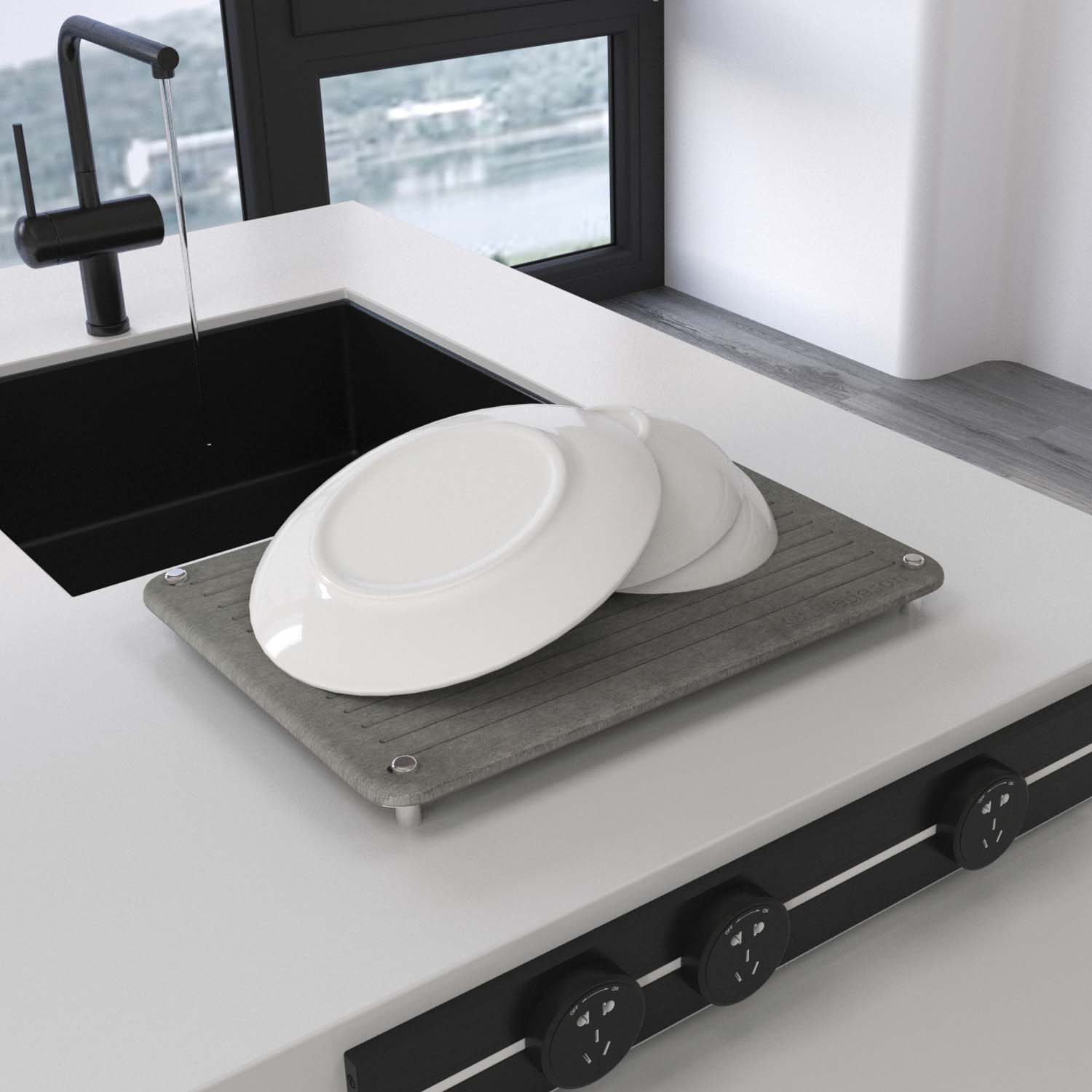
Your stone drying mat did not wear out. There is nothing in it to wear out — no fibers to flatten, no coating to peel, no foam core to collapse. What happens is simpler and more annoying: the microscopic pores that pull water off your plates slowly fill with soap film, calcium and cooking oil.
A blocked mat and a dead mat look identical on the counter. They are not the same thing. Almost every mat people throw away can be brought back in about five minutes with a piece of sandpaper — and the routine that stops it getting to that point takes less time than loading a dishwasher.
This is how to clean a stone drying mat properly — the care routine we use on the diatomite mats we sell, with the numbers behind it. It applies to any pressed diatomite mat, whoever made it.
Why a stone drying mat stops absorbing
Everything a diatomite mat does comes from one property: it is mostly air.
Diatomite is the fossilized silica shell of single-celled algae, mined, milled and pressed into a slab. The shells are riddled with holes, and the holes are what do the work — water is pulled in by capillary action, spreads through the slab, and leaves as vapor.
The published numbers are worth knowing, because they explain both why these mats work and why they eventually slow down. The US Geological Survey puts the bulk density of diatomite at 0.32–0.64 g/cm³, about a quarter to a half the density of water, and reports that it can take up 1.5 to 3 times its own weight in water. Industrial grades are quoted at anywhere from 70% to 92% porosity, depending on how the material was processed and how hard it was pressed.
Dissolved calcium from tap water. The stearate in dish soap. A smear of oil from the bottom of a pan. The water evaporates in minutes. The minerals and the fat stay behind, and every cycle leaves a little more of them sitting in the mouths of the pores.
So absorbency does not fail overnight. It slows down. First the stone drying mat holds a puddle for fifteen seconds instead of two. Then water starts standing in the middle where the plates sit. Then one morning you put a glass down and it slides — and you assume the stone drying mat is finished.
The five things that block the pores
Nearly every “dead” mat is blocked by one of five things. They are worth telling apart, because the fix is different for each, and only one of them needs sandpaper.
| What it is | Where it comes from | What you see | What clears it |
|---|---|---|---|
| Soap film | Dish soap, and dishes put down still sudsy | Water takes 30 seconds or more. A faint gray sheen that does not rinse away. | Rinse until the water sheets evenly — squeaky means soap is still there |
| Calcium & magnesium scale | Hard tap water drying on the surface | A white chalky haze, usually heaviest at the edge where water pools | Wipe with 1:1 white vinegar and water, rinse at once, then sand if it stays |
| Soap scum | Soap and hard water meeting on the surface | Waxy gray film that resists rinsing and holds fingerprints | Warm water and a soft brush, then a light sand |
| Cooking oil | Pan bases, butter knives, hands | A dark patch that never quite dries, and water that slows down right over it | Dry baking soda for 30 minutes to pull it out, brush off, then rinse |
| Pigment | Coffee, tea, red wine, turmeric, soy sauce | A brown or yellow shadow that survives normal rinsing | Baking soda paste for 15–30 minutes, then sand the residue away |
How to clean a stone drying mat: four steps, ten seconds
This is all a stone drying mat needs most weeks. It is deliberately less than people expect — the most common way to damage these mats is to over-clean them.
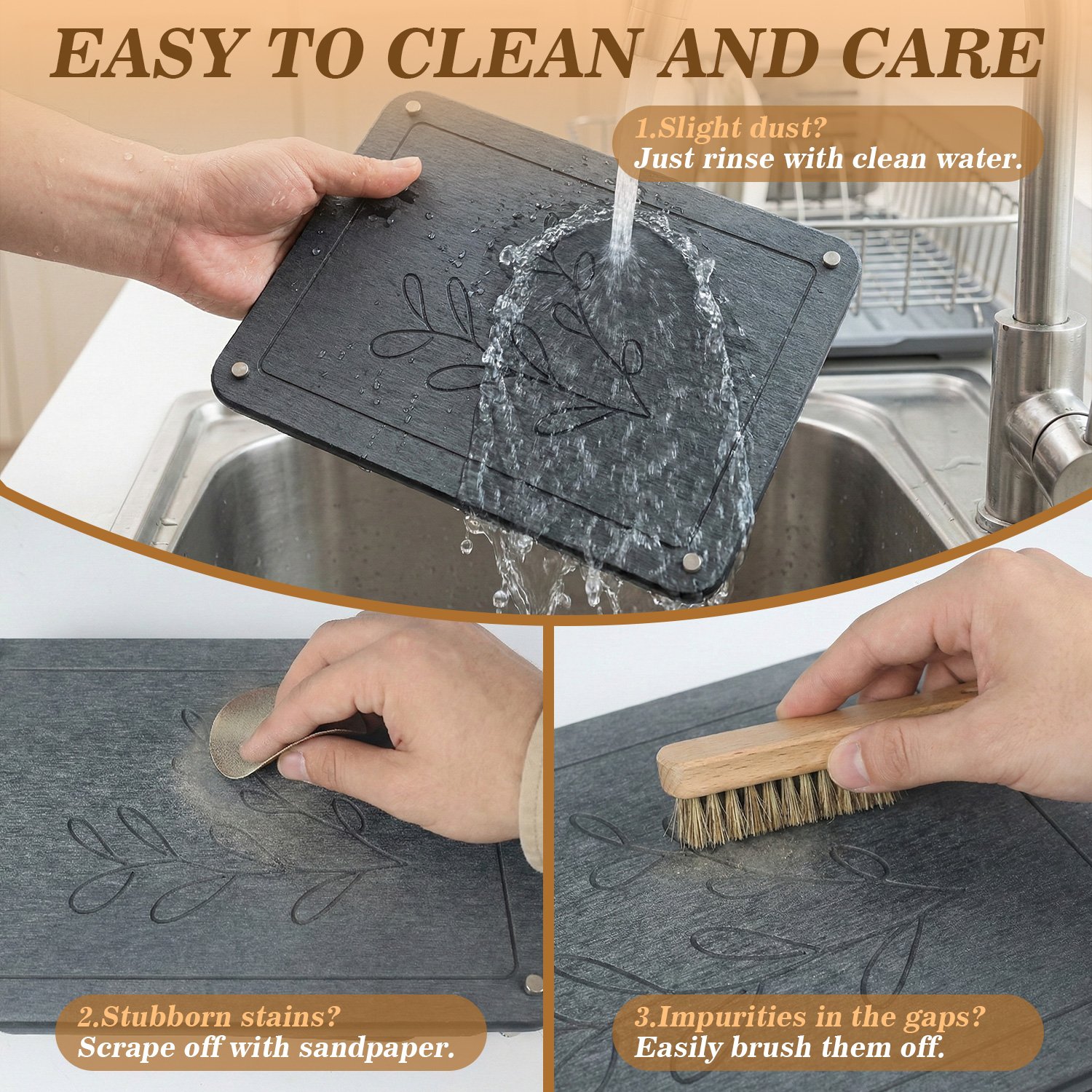
- 1Rinse both faces under warm water.Ten seconds. Not hot — hot water drives minerals into the surface as it evaporates. No scrubbing at this stage; scrubbing moves residue around the face instead of lifting it out.
- 2If it feels greasy, use one drop of mild soap. One.A soft sponge, straight passes, then rinse until water runs off in an even sheet. If the surface squeaks under your finger, there is still soap in it — and soap film is the single most common cause of a mat that stopped working. Plain water first, always.
- 3Stand it on its long edge.This is the step people skip, and it matters more than the rinse. A stone drying mat left flat dries on top in minutes while the underside stays damp for hours. That trapped moisture is what makes a self-drying mat smell.
- 4Wipe the counter underneath.The ring of water that collects under a mat is mineral-rich. Left there, it transfers straight back onto the slab next time it gets wet.

The test: is it blocked, or is it finished?
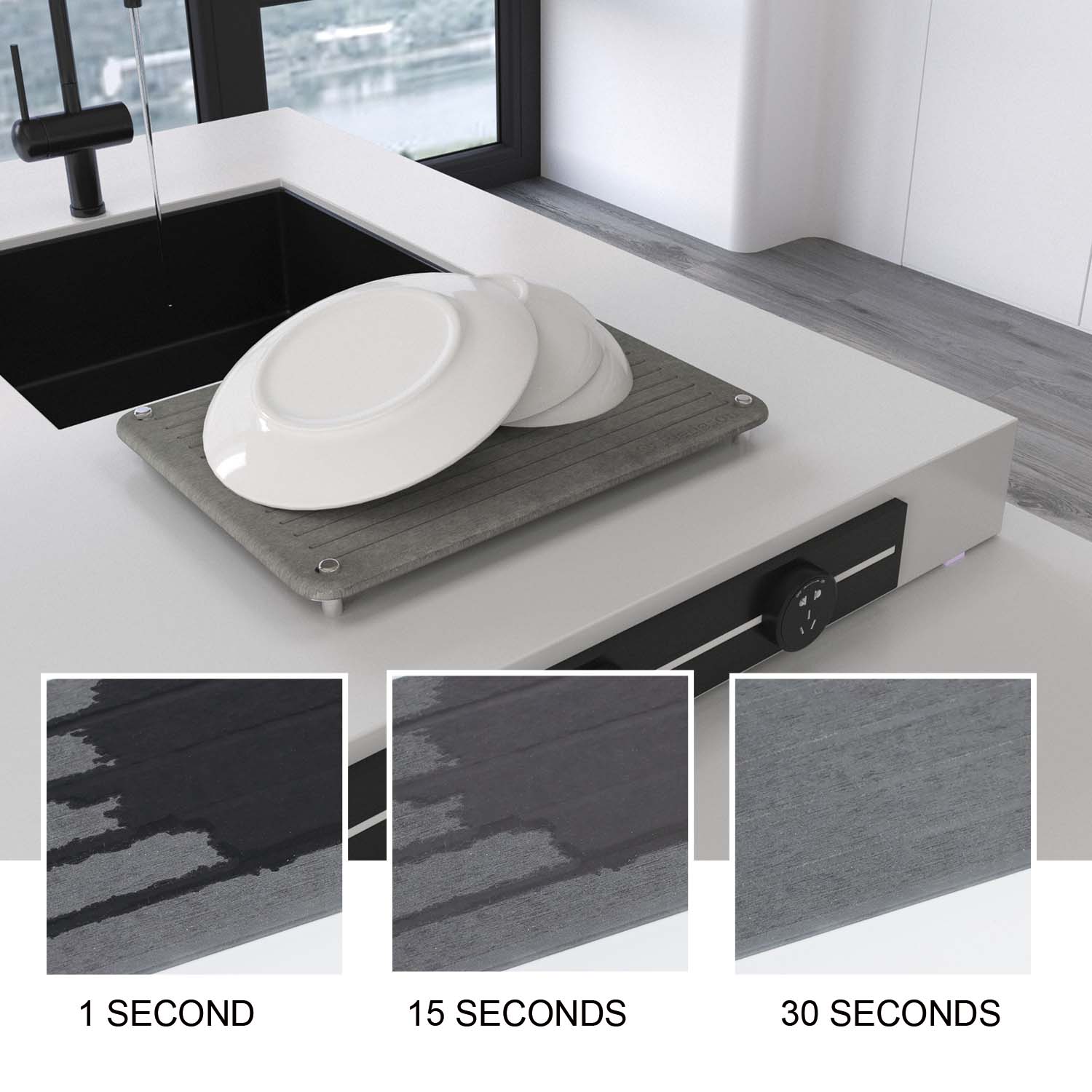
Before you spend five minutes sanding, spend ten seconds checking. Put a teaspoon of water in the middle of the face and count.
| Result | What it means | What to do |
|---|---|---|
| Gone in about 2 seconds | Working normally | Nothing. Keep rinsing weekly. |
| Gone, but takes 5–15 seconds | Pores are half closed | Sand now — this is the easy stage. |
| Beads up, sits for a minute or more | Blocked by film or scale | Vinegar wipe, then sand. |
| Beads on one patch only | Local oil or a stain | Baking soda on that patch, then sand. |
| Beads everywhere, right after sanding | Low-density or heavily filled slab | Nothing left to open. Replace it. |
How to clean a stone drying mat when rinsing stops working
Sanding sounds drastic. It is not. You are taking off a paper-thin layer of clogged surface to expose fresh stone underneath, and every pressed diatomite mat is designed to survive it several times over. It is routine maintenance, the same way you would re-oil a wooden board.
Most mats do not ship with a sanding pad, and you do not need one. A single sheet of 220–320 grit paper from a hardware store costs about a dollar and lasts years.
- 1Dry it first, completely.Sanding damp stone clogs the paper and polishes nothing. If the stone drying mat has been in daily use, give it a day standing on edge.
- 2Use 220 to 400 grit.220 for a stone drying mat that has gone a year or more, 320–400 for a light refresh. Anything coarser scratches the face, and scratches give minerals somewhere to grip next time.
- 3Light circles, almost no pressure.You are not trying to remove material. Two or three soft passes over each area, working across the whole face rather than grinding at one spot.
- 4Wear a mask and work near a window.The powder that comes off is fine silica dust. A quick pass on a dry mat does not throw much of it, but silica dust is not something to breathe in a closed room — a mask costs almost nothing.
- 5Wipe the dust with a dry cloth, then a barely damp one.Rinse the whole slab quickly and dry it on edge.
- 6Test with water again.It should disappear in a second or two. If it still beads, one more light pass — then stop. Repeated hard sanding on the same spot thins the slab.
How often? Once a year is enough on soft water. With hard water — and most of the US Southwest, Midwest and Florida counts — every three to six months. The stone drying mat will tell you: the water test is the schedule, not the calendar.
How many times can it take? Three to five resets over its life is realistic, because each pass removes a hair of thickness. If a mat needs sanding twice in two months, it was a low-density slab with a lot of filler, and no amount of care will fix that.
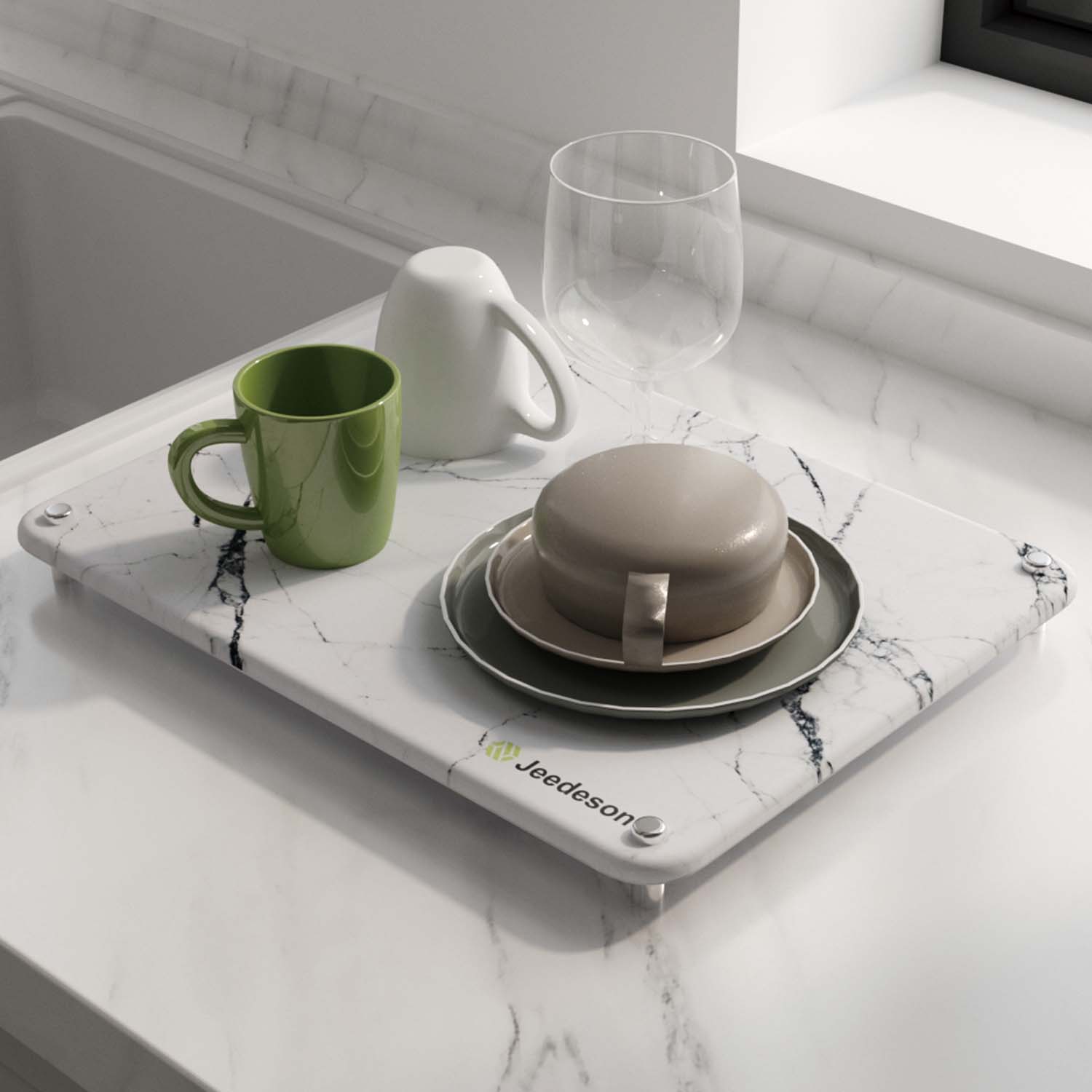
One thing that worries people with the marble-look mats: sanding does not rub the pattern off. The print on a printed diatomite mat sits below the surface, so a light pass takes the residue and leaves the veining. What it will do is even out a glossy patch, so sand the whole face rather than one corner.
Stain removal, by stain
Diatomite is porous, which is exactly why a colored liquid leaves a mark. The rule that matters: blot, do not rub. Rubbing pushes pigment deeper into the pores, which turns a two-minute fix into a permanent shadow.
| Stain | Treatment | If it survives |
|---|---|---|
| Coffee, tea, wine, soy sauce | Paste of 2 parts baking soda to 1 part water, spread thick, leave 15–30 minutes, wipe with a damp cloth | Sand the surface — pigment and pore-blocking film sit in the same layer |
| Turmeric, tomato, berry | Baking soda paste for 30 minutes; for a stubborn mark, 3% hydrogen peroxide on a cloth for 10 minutes, blot, rinse | Sand. Turmeric can leave a very faint warm tone that is cosmetic only |
| Oil and grease | Cover with dry baking soda for 30 minutes to draw the oil out, brush off, then one drop of mild soap and a thorough rinse | Repeat once. Deep oil may leave a slightly darker patch; it does not affect absorbency |
| White chalky film (hard water) | Cloth dampened with 1:1 white vinegar and water, wipe, rinse immediately | Light sand — scale that has crystallized sits below a simple wipe |
| Orange or rust-colored ring | Find what metal is touching it — a can, a rack, a steel utensil left sitting — and move it. Then baking soda paste | Sand. If it returns in the same place, the cause is still there |
| Soap scum | Warm water and a soft brush; baking soda paste on stubborn patches | Sand, then change how much soap you use |
Seven things that will finish a stone drying mat off
Most damaged mats were damaged by someone trying to clean them properly. These are the ones that actually do harm, with the reason each one is a problem.
- ✗The dishwasher — Heat and detergent drive residue deeper into the pores — the opposite of what you want — and the thermal shock cracks the slab. This is the single most common way these mats die.
- ✗Soaking it in soapy water — A cloth mat likes a soak. A stone mat absorbs the soap and keeps it. Soap film is the number one cause of lost absorbency.
- ✗Bleach and strong cleaners — Diatomite resists almost everything except strong alkali and hydrofluoric acid. Bleach is strongly alkaline: it attacks the binder, yellows the stone, and leaves residue sitting in the pores.
- ✗Oven, radiator or direct sun to dry it — The raw mineral melts around 1,400–1,750 °C, so heat is not the issue. Rapid temperature change is: a cold slab on a hot surface cracks along the weakest line.
- ✗A scouring pad or steel wool — It smears residue across the face instead of lifting it, and the scratches it leaves give the next layer of minerals somewhere to anchor.
- ✗Stacking cast iron on it — Massive diatomite is about 1.5 on the Mohs scale — talc-soft, and friable. It is strong under even compression and weak under a point load, which is why one heavy pan corner can crack a mat that survives being stood on.
- ✗Folding or stacking it while damp — Where two damp faces touch, nothing dries. That is where the smell comes from, and on a folding mat it is how the hinge joint warps.
Sand, or replace?
- Water beads or takes more than 5 seconds
- A chalky white haze you cannot rinse off
- A brown shadow on the face
- Six months or more of daily use with no maintenance
- A crack runs through the slab
- A corner has crumbled or chipped away
- Two sandings in a row change nothing
- It still smells after a full day of drying in open air
A stone drying mat that is only stained is not a broken mat. The pigment sits in the top fraction of a millimeter, it does not reach the structure, and it has no effect on how the stone drying mat performs. If the shadow bothers you, sand it; if it does not, keep using it.
Care changes with how a diatomite mat is built
The slab is the same material in every case. What changes is what is bolted to it, and where water can hide.
| Build | The extra step | Why |
|---|---|---|
| Solid slab with corner pads | Pull the silicone pads off once a month and wipe under them | Grit collects under the pads and grinds the counter; the slab itself is the easiest kind to sand |
| Slab on screw-in steel legs | Take the legs off before rinsing, and dry the threads | Water sits in the leg sockets, and scale seizes the thread so the leg will not come out next time |
| Two mats stacked as a tier | Never stack them while wet — dry both separately, then assemble | Water trapped between two faces has nowhere to evaporate to, which is the one reliable way to make a stone mat smell |
| Three nesting pieces | Dry the faces before nesting them, and tip the engraved face to drain the grooves | Nested while damp, the pieces keep each other wet; an engraved pattern gives water somewhere to sit |
The same routine works outside the kitchen
Diatomite mats end up under pet bowls, beside the bath, under plant pots and by the back door. The care does not change — rinse, stand on edge, sand when the water stops soaking in — but two of those spots need more attention than a sink does.
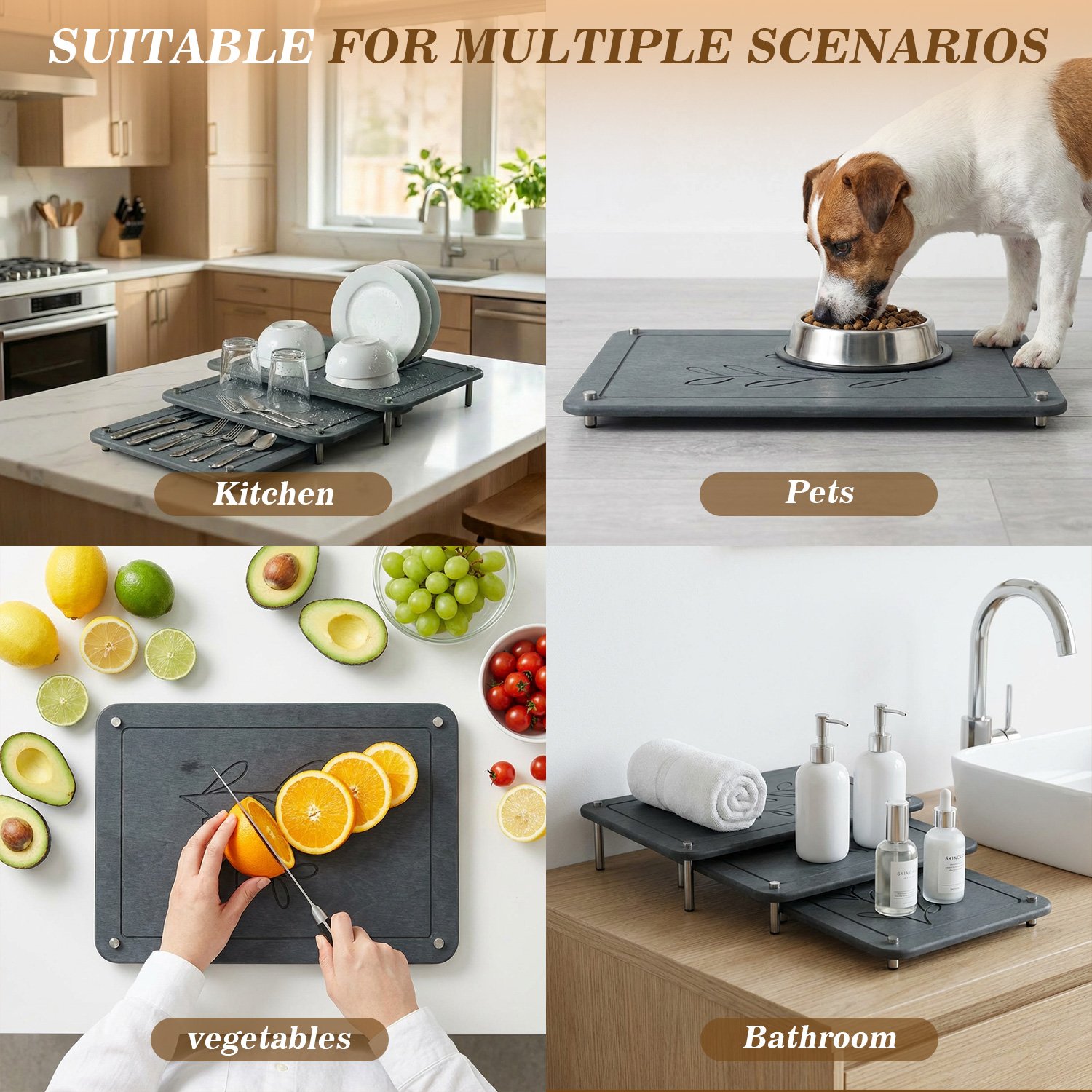
Under a pet bowl: kibble carries fat, and fat is the hardest thing to get out of a porous slab. Wipe the bowl ring weekly rather than waiting for the patch to go dark.
Beside a shower or bath: expect to sand every three months, not once a year. A bath mat takes more water in a week than a dish mat takes in a month, which means more mineral load, faster. Keep it out of standing water and never leave it propped against a wet wall.
If you want the longer version of that — humidity, slipping, why these mats behave differently in a bathroom — we wrote it up separately: diatomite mats in the bathroom.
If you are replacing it, buy by the job, not by the inch
The reason to sand a stone drying mat rather than replace it is that the material is the expensive part and it does not degrade. The reason to replace one is that it was the wrong size or the wrong density to begin with. Sizing is the decision that most people get wrong, and it is worth two minutes:
| What lands on it | What to buy | Footprint |
|---|---|---|
| A couple of plates, glasses, the coffee cups | One standard slab | 15.75 × 11.81 in |
| A full dinner service, sheet pans, a stock pot lid | One large slab | 15.4 × 23.6 in |
| Plates at the sink, bowls somewhere else | Two slabs | 2 × 15.75 × 11.81 in |
| Plates, glassware and cutlery at once, then put away flat | Three nesting pieces | 15.75 in down to 11.81 in |
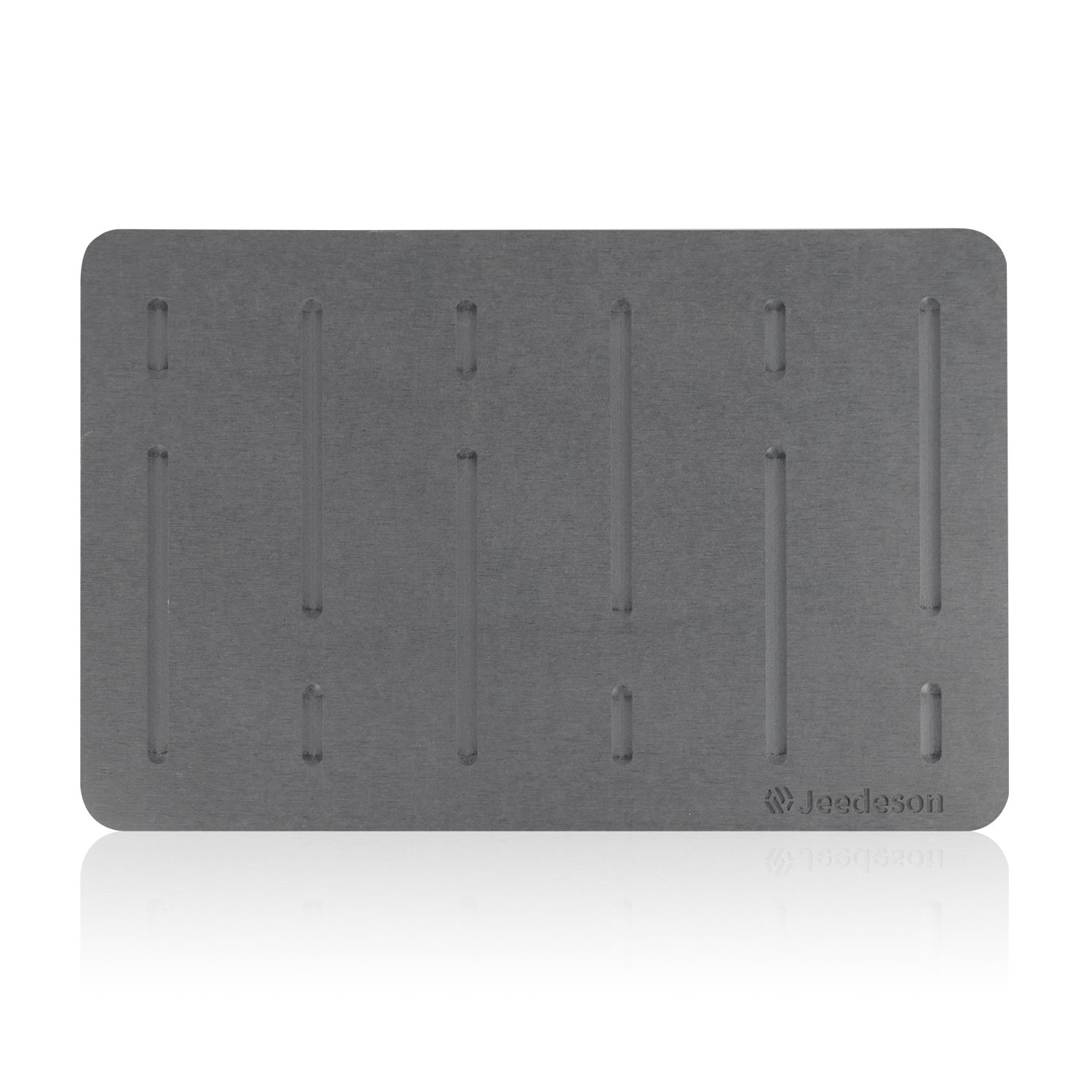
All of them are 9 mm pressed diatomite, and every one takes the same rinse-stand-sand routine described above. The difference is only how much counter it covers and whether the pieces nest or stack.



Questions we get asked most
How do you clean a stone drying mat?
Why does my stone mat smell musty?
Can I put it in the dishwasher?
Can I use vinegar on it?
How many times can I sand the same mat?
Why did my mat stop absorbing only two months after I bought it?
Is it safe to put dishes straight onto it?
Will a stone drying mat damage my countertop?
Can I sand a printed or patterned mat?
buy the density, not the price.
Every mat we sell is pressed diatomite with an open, sandable face — the kind that takes three to five resets instead of one. Same material, same care routine, four footprints.
Sources for the material figures: US Geological Survey Bulletin 2209-D (bulk density, water uptake, Mohs hardness of diatomite) and published industrial specifications for porosity range. Cleaning and sanding guidance reflects the care instructions published for pressed diatomite mats.