 Jeedeson Official Website
FLOORING BUYER’S GUIDE · UPDATED NOVEMBER 2026
Bamboo Flooring Pros and Cons: What the Spec Sheet Leaves Out
Where bamboo genuinely beats hardwood, where it quietly fails, and the six checks that separate a floor worth twenty years from a floor worth a complaint.
2,900 lbf
STRAND-WOVEN JANKA
3-5 yrs
TO HARVEST MATURITY
0.6 in
SOLID, SANDABLE CORE
Most bamboo flooring pros and cons articles are written from a brochure. They put “eco-friendly, hard, affordable” in one column and “water damage” in the other, then hand you a coupon. That is not enough to spend a renovation budget on.
Bamboo is grass. That single fact explains nearly every advantage and every failure mode below. It grows fast, it is dense, it moves with moisture, and it behaves differently depending on how the strips are cut, glued and pressed. Specify the construction correctly and you get a floor that tests harder than red oak for less money. Get it wrong and you get a floor that gaps in February and cups in July.
This guide is the measured version: published Janka and abrasion data, the installation tolerances that actually cause failures, and a room-by-room verdict you can act on.
The short answer, before the detail
Here is the condensed version of every bamboo flooring pros and cons point on this page, in one screen. The sections after it explain each line and where the number comes from.
| WHERE BAMBOO WINS | WHERE BAMBOO LOSES |
|---|---|
| Harder surface than red oak (strand-woven) | Not waterproof — standing water is the enemy |
| Harvested in 3-5 years, not 40-80 | Carbonized (dark) colors fade in direct sun |
| A 0.6 in solid core can be sanded 2-3 times | Dents under point loads before it scratches |
| Stable and quiet when installed as a floating floor | Needs indoor humidity held near 35-55% |
| Warmer underfoot than tile or SPC | Color shifts between production batches |
If you want one rule: strand-woven for pets and high-traffic rooms, solid carbonized for bedrooms, and something else entirely for a bathroom or a basement. The rest of this page is the reasoning behind that rule.
The pros that survive scrutiny
1. It is harder than the hardwood it imitates
The Janka test measures the force needed to embed a 0.444 in steel ball halfway into the surface. Red oak, the benchmark for American hardwood floors, rates 1,290 lbf. Strand-woven bamboo, which presses bamboo fibers into a dense block under heat and pressure, typically lands around 2,900-3,000 lbf — roughly 2.3 times harder.
Horizontal and vertical bamboo are a different story. Those are strip-built boards and rate closer to 1,380 lbf, with carbonized versions lower still because the heat treatment softens the fiber. The word “bamboo” on a box tells you almost nothing; the construction tells you everything. Reference values are published in the Wood Database if you want to check a specific species against a claim.
2. It regrows in three to five years
Moso bamboo reaches harvest maturity in three to five years. Oak needs 40 to 80. Because bamboo is a grass, harvesting the culm does not kill the plant — the root system sends up new shoots from the same stand. The International Bamboo and Rattan Organisation documents this cycle across producing regions.
That is a supply-chain advantage, not a marketing slogan. It is also why bamboo pricing has stayed more predictable than oak pricing through recent import cycles.

3. A 0.6 in solid plank can be sanded back to new
This is the advantage laminate and SPC cannot match at any price. A 15 mm (0.6 in) solid bamboo board has enough wear layer above the joint to be sanded and refinished two or three times over its life. A scratched engineered floor with a 2 mm veneer gets one sanding at most. A vinyl plank gets none.
Practically, that means a twenty-year-old bamboo floor in a rental or a family home can be brought back for the cost of a refinish rather than a replacement. Our own boards are built on that 0.6 in solid core precisely for this reason — see the solid bamboo flooring range for the thickness and packing details.
4. Low formaldehyde is achievable — if you ask for the report
Solid bamboo uses very little adhesive: the strips are pressed and the joint does the work. Strand-woven bamboo is the opposite — it needs resin to bind the fiber block, and that resin is where indoor-air complaints come from.
Bamboo flooring is not itself a “composite wood product” under U.S. federal rules, so a TSCA Title VI label is not automatic. What you can do is ask for an emissions test report and compare it against the EPA formaldehyde limits used for engineered wood: 0.05 ppm for hardwood plywood, 0.09 ppm for particleboard and MDF. A supplier who cannot produce a report is telling you something useful.
5. It feels warmer and quieter than tile or SPC
Dense bamboo has low thermal conductivity, so it does not pull heat out of a bare foot the way porcelain does. Installed as a floating floor over underlayment, it also damps impact noise — the difference between a second-floor bedroom and a drum.
The cons nobody prints on the box
The bamboo flooring disadvantages below are not hypothetical. Each one is a documented failure mode with a known cause, which means each one can be designed around — if you know about it before the quote is signed rather than after the first winter.
1. “Waterproof” is the wrong word
Bamboo is a hydrophilic material. It absorbs moisture, swells, and does not fully return to its original thickness when it dries. Spills wiped up within a few minutes are a non-event. Water that sits — a leaking dishwasher line, an overflowing plant saucer, a bath mat left soaking — will stain the finish and eventually swell the core.
SPC and WPC are genuinely waterproof because they contain no wood fiber. Bamboo is water-resistant, and any listing that blurs the two is either careless or dishonest. If the room floods twice a year, bamboo is the wrong material.

2. Carbonized color fades in direct sun
The deep honey and coffee tones in carbonized bamboo come from a steam-and-heat process, not a stain. That process caramelizes the sugars in the fiber, which darkens it — and also drops the Janka rating to roughly 1,180 lbf.
UV exposure reverses some of that color over years. A floor under a south-facing sliding door with no blind will go lighter in patches while the rest of the room holds its tone. The fix is preventive: UV-filtering glass film, sheers, or rugs rotated seasonally. If you want a color that stays put for decades, choose a natural or light honey tone rather than the darkest one.

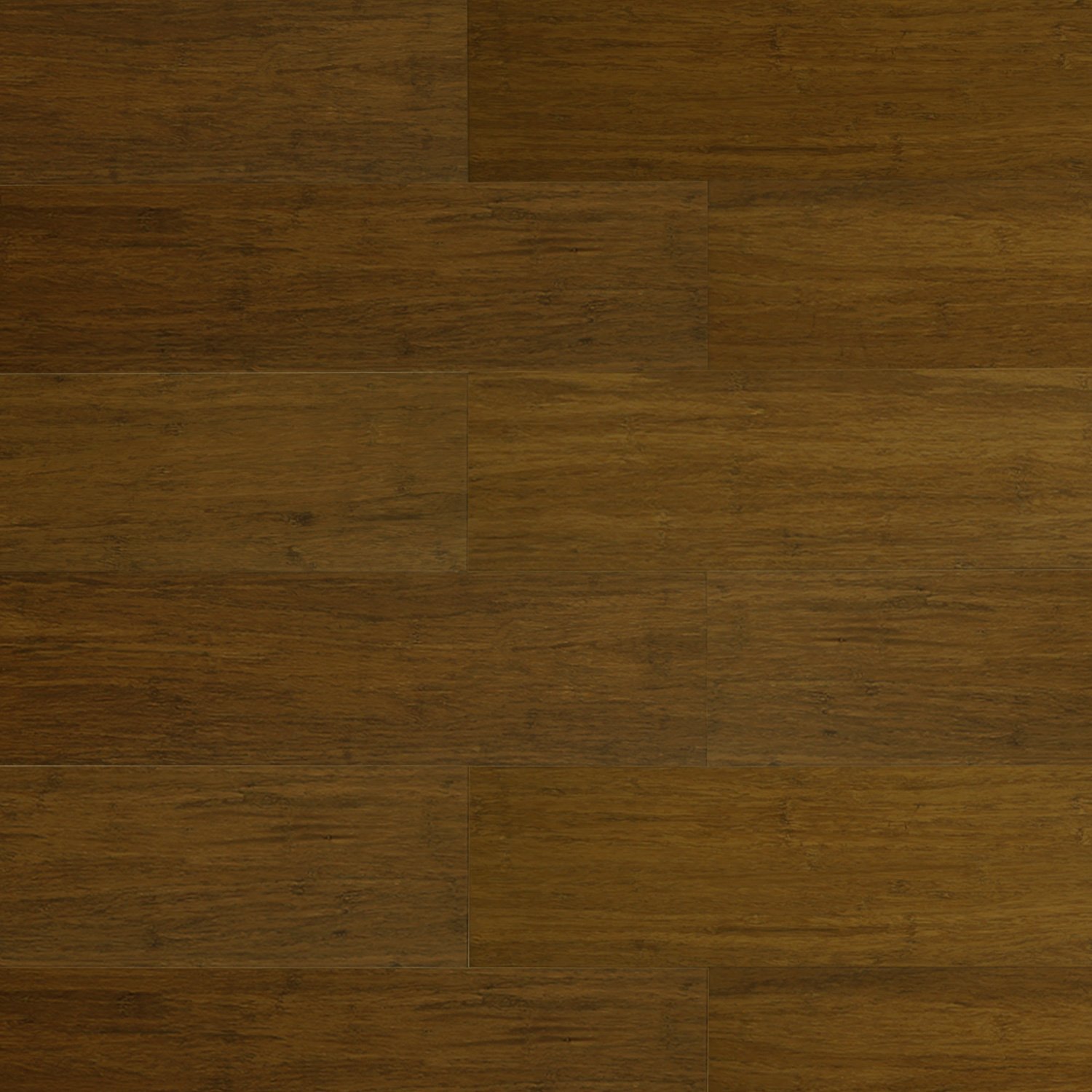
Carbonized strand-woven bamboo, close up. The color runs through the board, not on top of it — which is why a scratch shows as a lighter line rather than a white gouge.
3. It dents before it scratches
Hardness and toughness are not the same property. Bamboo resists a sharp blade extremely well, which is why it outperforms oak in a scratch test. But a high Janka number also means a stiff, brittle surface: dropped tools, stiletto heels, and the corner of a cast-iron pan leave small dents that no scratch test will predict.
Dog claws are the classic case. A 60 lb dog sprinting across a hallway puts a point load on four small contacts, and over a year that shows as a trail of shallow dimples in the traffic lane. Strand-woven holds up far better than horizontal bamboo here, and felt pads under every leg of every piece of furniture cost almost nothing. Our durability breakdown covers the dent-versus-scratch distinction with test detail.
4. Humidity swings open the seams
Wood-floor failures are mostly moisture failures. The National Wood Flooring Association guidance for wood flooring installation calls for indoor relative humidity held roughly in the 35-55% band, with temperatures between 60 and 80°F, and for the flooring to acclimate to the room before installation.
Below that band, boards shrink and gaps open at the short ends. Above it, edges cup upward. A house with a whole-house humidifier in a cold climate and a house with no dehumidifier in the Gulf states both need to think about this before they choose bamboo, not after.
Floating installations need a real expansion gap at every wall, hidden under the baseboard. Installers who skip it because the gap “looks messy” are the reason some floors tent in the middle of a room eighteen months later. The step-by-step is in our solid bamboo installation guide.
5. Color varies from box to box
Bamboo is a plant, not a print. Two pallets produced months apart will not match exactly, especially in carbonized tones. Buy the whole job in one order, add 10% for cuts and future repairs, and open every box before the installer starts so you can blend boards from different cartons across the room instead of creating a visible band at the far wall.
Bamboo vs red oak vs SPC, side by side
| STRAND BAMBOO | RED OAK | SPC VINYL | |
|---|---|---|---|
| Janka hardness | ~2,900 lbf | 1,290 lbf | Not rated (wear layer) |
| Water behavior | Resistant, swells if soaked | Resistant, swells if soaked | Waterproof core |
| Refinishable | Yes, 2-3 times at 0.6 in | Yes, 2-3 times | No |
| Feel underfoot | Warm, quiet | Warm, quiet | Hard, louder |
| Best rooms | Living, bedroom, pet areas | Living, bedroom, dining | Kitchen, bath, basement |
| Relative cost | Mid | High | Low to mid |
Values are typical ranges, not guarantees. A specific product can sit outside them, which is why the bamboo flooring pros and cons table above separates construction from species. The full comparison against oak — including how each ages and what each does to a resale appraisal — is in bamboo flooring vs wood flooring.
Room by room: where bamboo is the right call
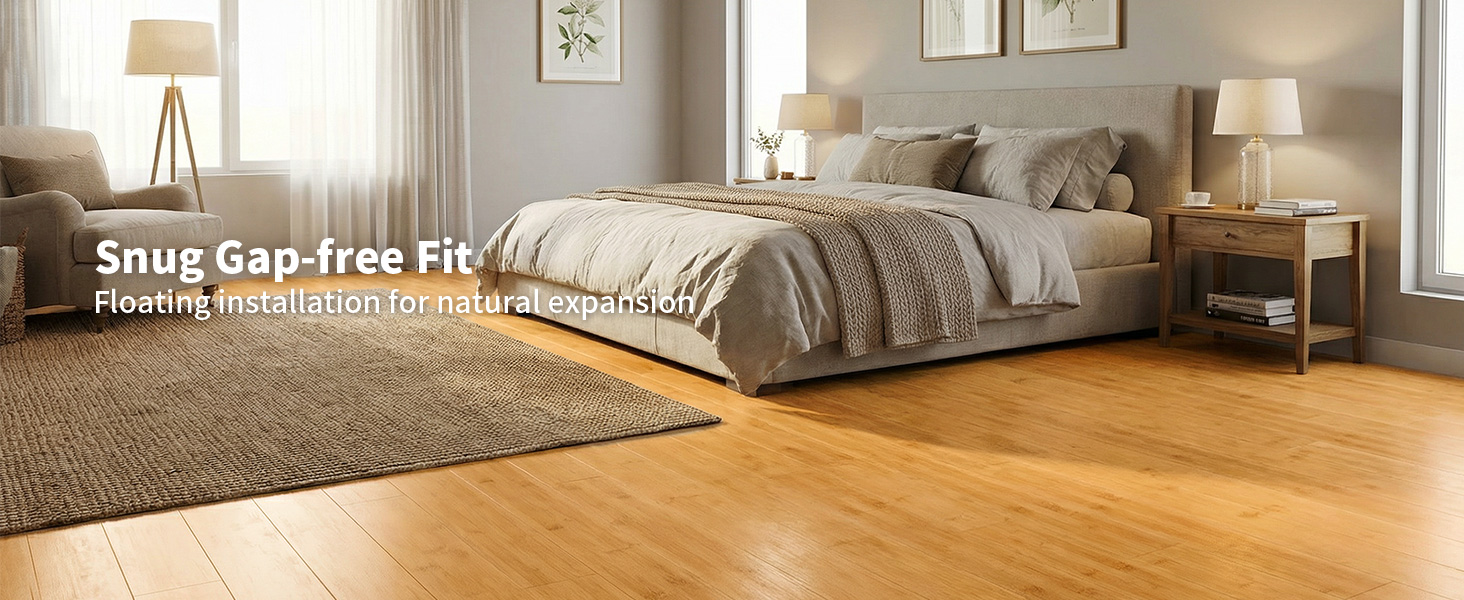
Light honey bamboo in a bedroom. This is the room type where bamboo has the fewest arguments against it: low moisture, low point loads, controlled light.
Living room and bedroom. Yes. These are the rooms bamboo was made for. Foot traffic is distributed, moisture events are rare, and the warmth underfoot is a genuine upgrade over tile.
Kitchen. Yes, with two rules: a mat at the sink, and spills wiped within minutes rather than hours. A dishwasher leak is the one failure that ruins a bamboo kitchen floor, so check the supply line annually. Strand-woven is the better choice here because the traffic lane in front of the counter takes a beating.
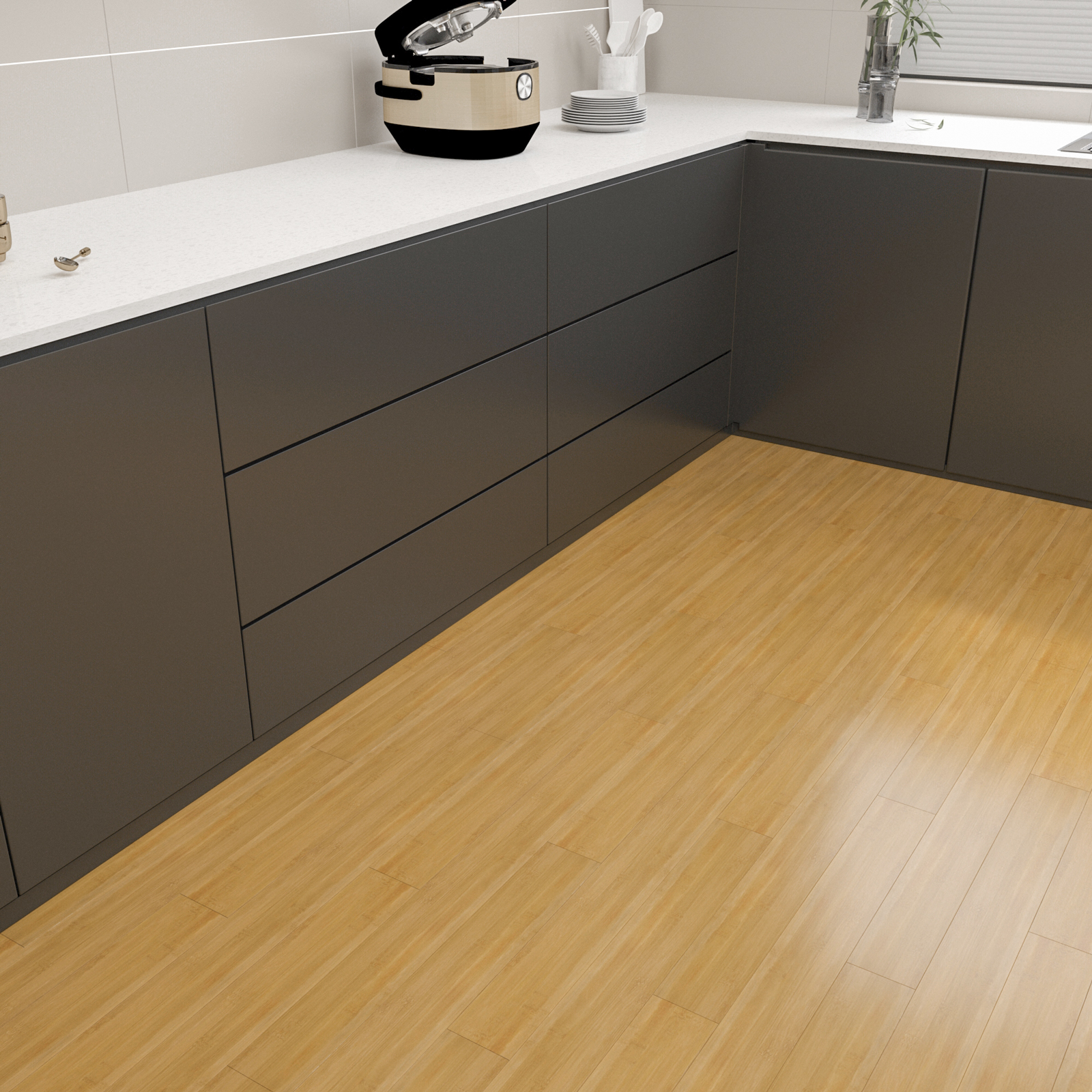
Bamboo works in a kitchen when the sink zone is protected and leaks are caught early. It does not work as a wet room.
Bathroom. No. Not because the finish fails immediately, but because a bathroom combines standing water, steam, and a wet mat sitting on the surface for hours. Even a well-sealed solid bamboo floor is being asked to do something it was not designed for. Use tile or SPC and put bamboo in the adjacent hallway.
Basement. No, unless the slab has a verified vapor barrier and a dehumidifier runs year-round. Below-grade humidity swings are exactly the condition bamboo handles worst.
Bamboo flooring for dogs. Yes, with the right construction. Strand-woven bamboo is the only version we recommend for a household with large dogs, because its density resists the point loads that dent strip-built boards. Keep claws trimmed, put a runner in the main sprint path, and accept that a floor is a wear surface, not a museum piece. For a deeper look at the trade-off, read real bamboo flooring before-and-after rooms.
Radiant heat. Usually yes, but only if the manufacturer’s spec allows it. Most solid bamboo systems cap the surface temperature around 80°F and require a slow ramp-up. Installing over hydronic heat without checking that limit is how you get a floor with no gaps in the middle and open seams at every wall.
The rule that saves the most money: bamboo is a dry-room floor. Every failure story you will read online traces back to water that stayed too long, humidity that was never controlled, or an expansion gap that was never left. None of those are material defects.
Horizontal, vertical, or strand-woven?
Three constructions, three different floors, one word on the box. Strand woven bamboo flooring is the one most buyers actually want — it is the only version that holds up to large dogs and the only one whose hardness claim survives a Janka test.
HORIZONTAL
Classic look
Strips laid flat. Visible node pattern, ~1,380 lbf. The most traditional bamboo floor, and the most sensitive to humidity.
VERTICAL
Linear grain
Strips on edge. Tight, modern lines, slightly harder than horizontal. Popular in contemporary interiors.
STRAND-WOVEN
The tough one
Fibers pressed into a block. ~2,900 lbf, best moisture stability, best for dogs. Heavier and more resin, so ask for the emissions report.
If the choice is between “solid” and “engineered” rather than between grain directions, that is a separate decision about core construction and where the floor can be installed — covered in solid vs engineered bamboo flooring.
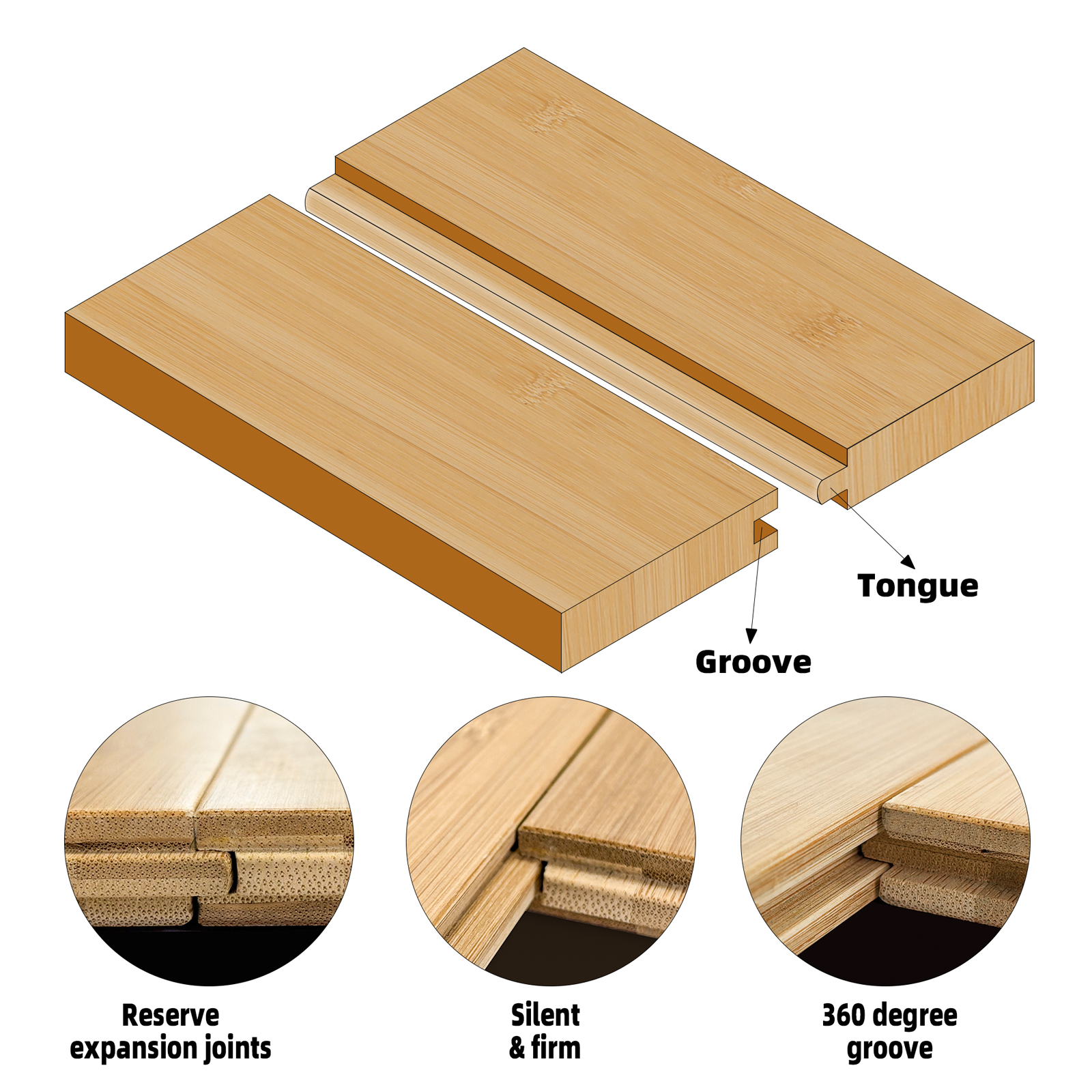
The joint is where a cheap floor reveals itself. Look for a machined tongue that seats fully, a groove with room for seasonal movement, and no chip-out at the ends.
Six checks before you pay
These are the questions that separate a floor that lasts from a floor that generates a review. Every bamboo flooring pros and cons list you read online is really a list of specifications — so ask for the specifications. Do it before money changes hands, not after delivery.
1. Look at the core, not the face. A quality board shows tight, consistent layers with no voids. A cheap one shows gaps, dark pockets, and filler. The difference is visible on the end of an offcut.
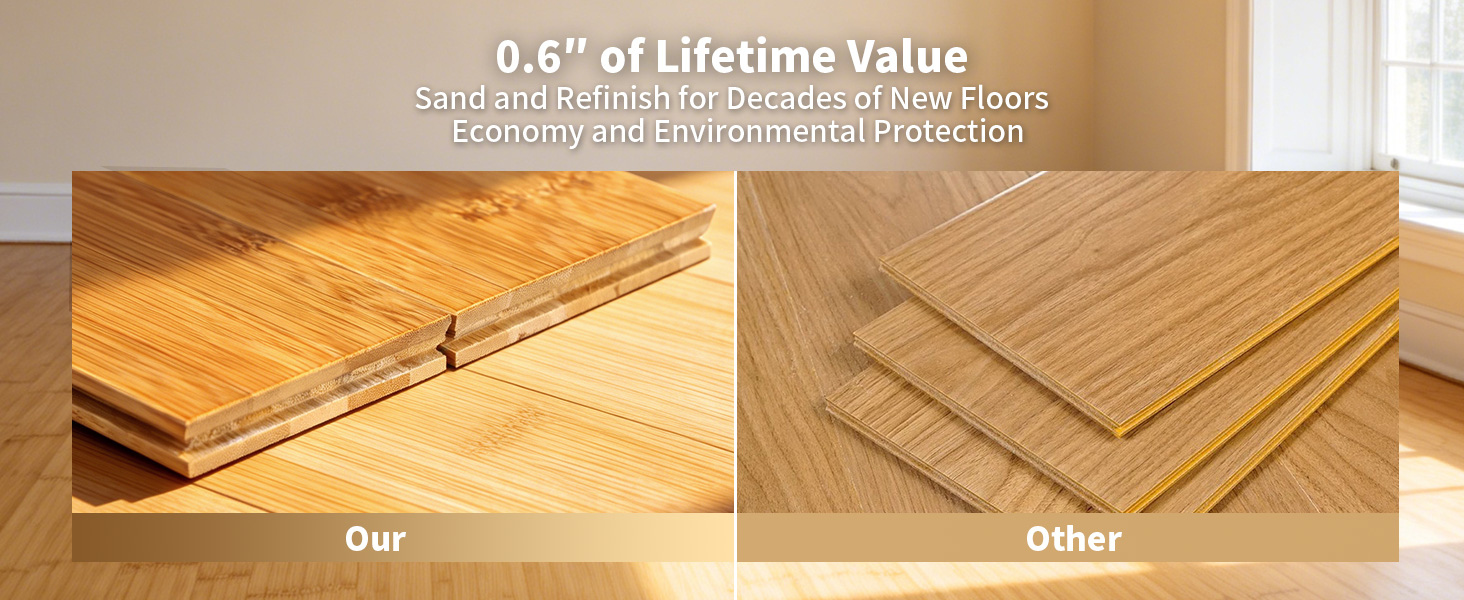
Same nominal thickness, different amount of usable material above the joint. The left board can be sanded more than once. The right one cannot.
2. Ask for density in g/cm³. Strand-woven should read well above 0.9. Strip-built bamboo typically sits around 0.68-0.80. A supplier who does not know the number does not control the process.
3. Ask how it was carbonized. The correct answer is heat and steam, through the body of the strip. If the answer is “we stain it,” you are buying a color, not a carbonized floor — and the color will behave like a coating.
4. Ask for the formaldehyde report. Compare the number against the EPA limits above. “Eco-friendly” is a word; a lab report is a measurement.
5. Ask for the moisture content and the acclimation window. Boards packed at 6-9% and acclimated 48-72 hours in the room perform very differently from boards installed straight off a truck in January.
6. Check the joint tolerance on three boards. Fit two planks together dry, sight down the seam, and run a fingernail across it. A lip you can feel on day one becomes a trap for grit and a visible line by year two.
What actually drives the price
Bamboo is usually cheaper than oak and more expensive than mid-grade SPC, but the spread inside the bamboo category is wider than the spread between categories. Four things move the number:
1. Construction. Strand-woven costs more to make than strip-built because it uses more fiber and more resin per square foot.
2. Thickness. A 0.6 in solid board uses roughly twice the material of a 0.31 in engineered plank, and it is the thickness that makes refinishing possible.
3. Finish. A UV-cured aluminum-oxide coating costs more than a basic lacquer and is the difference between a floor that shrugs off grit and one that dulls in the entryway.
4. The job around the floor. Underlayment, trim, transitions, removal and disposal of the old floor, and a 10% waste factor routinely add more to the invoice than the upgrade from one bamboo grade to the next.
For the line-item version, including how the numbers moved through 2025, see the solid bamboo flooring cost guide. Treat those ranges as a starting point for a quote, not as a current price — material costs have moved since it was published.
On resale: appraisers value “hard surface flooring” as a category. Bamboo does not carry the automatic premium that site-finished oak does in a historic neighborhood, and it is not penalized either. What buyers react to is the condition of the floor and whether the color reads current. A well-installed light honey bamboo floor photographs like hardwood and shows well in a listing. A gappy, faded floor does the opposite, whatever the material.
Who should not buy bamboo
Bamboo is not a universal floor, and pretending otherwise is how people end up disappointed.
1. You are flooring a bathroom or a basement. Choose tile, SPC, or polished concrete.
2. You want the cheapest floor per square foot. Entry-level SPC wins, and it will tolerate conditions bamboo will not.
3. You refuse to control indoor humidity. In a dry-climate winter or a humid coastal summer, bamboo needs a humidifier or dehumidifier to stay tight.
4. You are installing over an unverified slab. Test for moisture first. A floor laid on a wet slab fails regardless of what it is made of.
5. You want a perfectly uniform, printed-looking surface. Bamboo has visible nodes and batch variation. That is the material being honest about what it is.
Frequently asked
Is bamboo flooring worth it?
For a dry room with controlled humidity, yes. Weighing the bamboo flooring pros and cons comes down to one trade: you get a surface harder than red oak and a floor that can be refinished, in exchange for accepting that it is not waterproof and it needs stable indoor air. It stops being worth it the moment the room is wet or the humidity is uncontrolled.
How long does bamboo flooring last?
A solid 0.6 in strand-woven floor in a normal indoor environment typically runs 20-25 years, longer if it is refinished once. Thin engineered bamboo with a 2 mm wear layer is closer to 10-15 years because it cannot be sanded back.
Is bamboo flooring good for dogs?
Strand-woven is, strip-built is not ideal. The failure mode with pets is denting from point loads, not scratching, and density is what resists it. Trim claws, use a runner in the sprint path, and expect some traffic-lane wear over a decade. If a scratch-proof floor is the priority above all else, SPC is the more forgiving choice.
Can you put bamboo flooring in a bathroom?
We do not recommend it. Steam, standing water, and a wet mat left on the surface are the three conditions bamboo handles worst. A powder room used occasionally is a judgment call; a full bathroom is not.
Does bamboo flooring add resale value?
Bamboo flooring resale value is not a separate line on an appraisal. It contributes as hard-surface flooring and photographs well when it is in good condition, but it does not command the premium of site-finished oak in every market. Condition and color matter more than the species name on the listing sheet.
Is bamboo flooring real hardwood?
No. Bamboo is a grass, and the manufacturing process is closer to an engineered wood product than to a sawn oak board. That does not make it inferior — it makes it different, and the differences are what this page is about.
The bottom line on bamboo flooring pros and cons
Bamboo earns its place in a home when three things are true: the room is dry, the indoor humidity is managed, and the construction matches the traffic. Under those conditions it is one of the few floors that is harder than oak, refinishable, and grown on a three-to-five-year cycle.
It loses when any one of those three is false — and no finish, underlayment, or warranty changes that. The bamboo flooring pros and cons are not evenly balanced, and they are not the same for every house. They resolve almost entirely on where the floor goes and which board you buy.
See the floors, then decide
Specifications get you to a shortlist. Color and grain get you to a decision. Both are easier to judge on a finished floor than on a swatch.
Start with the full bamboo flooring collection — seven constructions, from click-lock light honey to carbonized strand-woven coffee. Two good entry points:
1. Wide-plank light honey bamboo — the bedroom and living-room workhorse, 5.12 in wide planks, click-lock.
2. Embossed walnut solid bamboo — the darker, textured option for a room that needs contrast.
DATA AND STANDARDS REFERENCED
1. Janka hardness values: The Wood Database. Test method embeds a 0.444 in steel ball to half its diameter.
2. Bamboo growth and harvest cycles: International Bamboo and Rattan Organisation (INBAR).
3. Humidity and acclimation guidance: National Wood Flooring Association.
4. Formaldehyde emission limits used for comparison: U.S. EPA, formaldehyde and TSCA Title VI.
5. Abrasion resistance is commonly measured to ASTM D4060 (Taber). Ask suppliers for the cycles-to-failure figure for the finish, not just the wear-layer thickness.
SEE MORE REAL ROOMS
Finished installations, close-ups and before-and-after comparisons go up on our social channels first: the bamboo flooring Pinterest board and YouTube (@jeedesondecor). If you are still choosing between materials, the cleaning and maintenance side is covered in how to clean bamboo floors.